
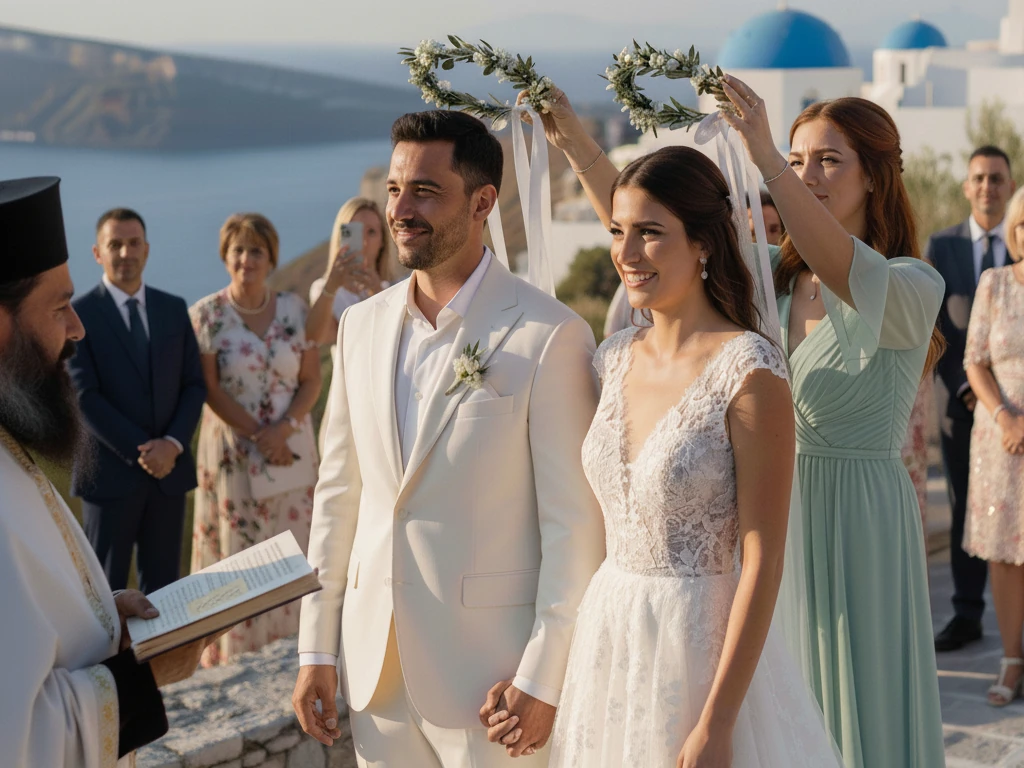
Greek wedding stefana are sacred orthodox wedding crowns that transform couples into royalty during their ceremony. This comprehensive guide covers everything from ancient stefana history and deep stefana meaning to choosing perfect stefana designs, DIY tutorials for making your own from olive branches, and preserving these precious keepsakes in a stefanothiki. Whether you’re planning an orthodox wedding ceremony or honoring heritage, discover how stefana create the most meaningful moment of your celebration while supporting charitable causes like Hamogelo tou Paidiou.
Table of Contents
When my fiancé and I were planning our destination wedding in Crete, I became completely fascinated by the story behind our stefana – those delicate, interconnected crowns that would transform us into the king and queen of our new household. What started as choosing pretty wedding accessories led me down a captivating journey through 2,500 years of Greek history, ancient symbolism, and modern traditions.
Whether you’re planning a Greek Orthodox ceremony, honoring your heritage, or simply drawn to the beauty of these sacred crowns, understanding these sacred Greek wedding crowns (stefana) adds profound meaning to your celebration. From their origins as Olympic victory wreaths to their role in today’s destination weddings, stefana represent one of the most beautiful and enduring Greek wedding traditions.
What Are Greek Wedding Stefana?

Example of a hand made metal stefana with porcelain olive leaves.
Greek wedding crowns, known as Stefana (pronounced steh-fah-NAH), are the ceremonial wedding crowns worn by couples during Greek Orthodox ceremonies. Unlike rigid royal crowns, these delicate creations are typically made from flowers, precious metals, or decorative materials, connected by a ribbon that symbolizes the eternal bond between husband and wife.
But stefana aren’t just beautiful accessories for your Greek wedding. They carry profound spiritual significance that transforms your ceremony into something sacred. The stefana meaning extends far beyond decoration – they represent your transformation into the rulers of your new family kingdom, blessed by God and witnessed by your community.
During the stefana ceremony, these crowns are placed on your heads by the priest, then exchanged three times by your koumbaro or koumbara in one of the most moving moments of the entire celebration. You’ll wear them throughout the remainder of your Orthodox wedding ceremony, creating some of the most stunning wedding photos you’ll ever have.
After the wedding, your stefana become precious keepsakes, traditionally displayed in your home as a daily reminder of your sacred commitment. Many couples keep them in a special case called a stefanothiki, often passing them down through generations as family heirlooms.
The Ancient Origins: From Olympic Victors to Wedding Royalty

The fascinating history of stefana reaches back to ancient Greece, long before Christianity arrived. Understanding these origins adds incredible depth to your wedding tradition.
Victory Wreaths and Divine Honor
In ancient Greece, wreaths called “stephanos” crowned Olympic victors, honored military heroes, and adorned participants in religious ceremonies. These weren’t wedding crowns initially – they were symbols of triumph, divine blessing, and honor bestowed by the gods.
The materials held deep meaning: olive branches represented peace and victory, laurel symbolized honor and achievement, and myrtle honored Aphrodite, the goddess of love. When you choose stefana today, you’re participating in a tradition that once crowned the greatest athletes and heroes of the ancient world.
Here’s what amazes me most: stefana actually influenced the idea of the crown we associate with royalty today. The circular shape, the delicate materials, the symbolic weight – these elements traveled from ancient Greek temples, to Byzantine emperors, and later to royal courts across Europe. Modern royal crowns evolved from the same principles that guide stefana design.
A carefully crafted stefana is a perfect elegant complement to the Ancient Greek wedding aesthetic and Greek Goddess wedding dress.
The Christian Transformation
When Christianity spread through Greece, early church leaders faced a dilemma: many pagan traditions were deeply meaningful to converts, but they carried non-Christian symbolism. Rather than abandon the crown tradition entirely, the Orthodox Church transformed it.
The Church reinterpreted the crowns’ meaning from secular honor to sacred blessing. Instead of honoring athletic victory, stefana began representing the spiritual victory of choosing marriage, the honor bestowed by God, and the divine blessing on the union.
This transformation shows how Greek wedding traditions evolved while maintaining their essential beauty and meaning. Today’s stefana ceremony combines ancient symbolism with Christian spirituality, creating something uniquely profound.
Sacred Symbolism in Greek Orthodox Tradition

The Orthodox stefana ceremony is loaded with symbolism that makes your wedding crowns far more meaningful than beautiful accessories.
Becoming Crowned in God’s Eyes
When the priest places stefana on your heads, you’re symbolically crowned with the honor and glory that God bestows on married couples. In Orthodox theology, this represents your new roles as spiritual partners in creating a ‘domestic church’ – your family becomes a small reflection of the Church itself, where you’ll serve together with mutual love and responsibility.
The stefana ceremony declares that your marriage isn’t just a legal contract or romantic partnership; it’s a sacred sacrament where you’ll serve God together as partners in creating your own domestic church. This transforms how you view your relationship – from individual desires to shared spiritual mission of mutual love and service.
The Connecting Ribbon’s Deep Meaning
The ribbon linking your stefana isn’t just practical – it’s profoundly symbolic. As you move through the ceremony, you’re literally connected, unable to go in different directions. This represents your commitment to move through life together, sharing the same path regardless of what comes.
During the Dance of Isaiah, when you walk around the altar three times while wearing your stefana, the ribbon ensures you move as one unit. Your koumbaro or koumbara often holds the ribbons, representing how your spiritual community supports your united journey.
The Circle of Eternity
The circular shape of stefana represents eternal love with no beginning or end. Unlike other wedding symbols that might break or fade, the circle remains perfect and unbroken, just like your commitment to each other.
This symbolism becomes especially meaningful when you display your stefana in your home after the wedding. Every time you see them, you’re reminded not just of your wedding day, but of the eternal nature of your bond.
The Stefana Ceremony: Step-by-Step Guide


Understanding what happens during the stefana ceremony helps you appreciate this beautiful tradition and prepare for one of your wedding’s most moving moments.
The Blessing and Placement
Your priest begins by blessing the stefana, making the sign of the cross over them while reciting prayers. The blessing transforms these crowns from beautiful objects into sacred symbols of your union.
The priest then places the stefana on your heads – first the groom, then the bride – while reciting specific prayers that declare you crowned “in the name of the Father, and of the Son, and of the Holy Spirit.”
This moment often brings tears to couples and guests alike. There’s something profoundly moving about being crowned before God and your community, officially beginning your reign as a married couple.
The Triple Exchange

Here’s where your koumbaro or koumbara plays their crucial role. They carefully exchange the stefana between you and your partner three times, representing the Holy Trinity and the sacred nature of your commitment.
This exchange must be done with reverence and care – the stefana are blessed objects, and this moment validates your Orthodox marriage. Your koumbaro/koumbara literally participates in making your marriage official through this sacred act.
From our experience, this is when the ceremony becomes deeply emotional. Watching your closest friend or family member perform this sacred duty, knowing they’re participating in creating your marriage, is incredibly moving.
The Common Cup and Dance of Isaiah

While wearing your stefana, you’ll participate in the Common Cup ritual, sharing blessed wine that represents your commitment to share everything in married life – joys and sorrows alike.
The ceremony concludes with the Dance of Isaiah, where you walk around the altar three times while wearing your stefana. Your koumbaro and koumbara follow behind, often holding your stefana ribbons together, representing their ongoing support for your marriage.
These final moments, crowned and connected, taking your first steps as a married couple with your spiritual community supporting you, create memories that last forever.
Types of Stefana: Understanding Your Style Options
When planning your Greek wedding, choosing stefana involves understanding the three main style categories that dominate today’s market.
Traditional Botanical Stefana


Hand-made stefana by Craft Stories on Etsy.
These stefana honor the ancient origins with natural materials:
- Materials: Metal olive leaves, porcelain flowers, silk flowers, or even fresh botanicals
- Symbolism: Connects directly to ancient wreaths while honoring nature’s beauty
- Best for: Couples wanting authentic Greek styling, outdoor weddings, traditional Orthodox ceremonies
- Price range: €135-€185
Traditional botanical stefana work beautifully for destination weddings in Greece, especially ceremonies in olive groves or gardens. They photograph gorgeously against Mediterranean landscapes and honor the agricultural heritage of Greek culture.
Modern Metal Stefana


Handmade examples from Kostis Designs on Etsy
Contemporary couples often choose refined metal designs:
- Materials: Gold-plated (24K), silver-plated, or sterling silver with minimal ornamentation
- Styles: Twisted wire designs, Greek key patterns, hammered textures
- Best for: Formal venues, contemporary couples, minimalist aesthetics
- Price range: €122-€256+
Current trend: Minimalist twisted-metal designs are hugely popular for 2026-2027 weddings. These stefana offer timeless elegance that photographs beautifully and works with any wedding style.
Pearl and Crystal Stefana


Handmade example from Lucy Love Events Co. on Etsy
For couples wanting glamorous stefana:
- Materials: Swarovski crystals, freshwater pearls, Austrian crystals
- Styles: Range from simple pearl strands to elaborate crystal arrangements
- Best for: Evening ceremonies, formal receptions, couples who love sparkle
- Price range: €130-€240
Emerging trend: Rough, unrefined pearls are becoming popular for couples wanting organic elegance with glamorous touches.
How to Choose Your Perfect Stefana


Photo Credit Tessarellahouse
Selecting stefana involves balancing tradition, personal style, and practical considerations for your destination wedding.
Consider Your Venue and Style
Your wedding location should influence your stefana choice. Beach ceremonies in Santorini suit flowing, organic designs, while historic venues might call for more formal metal stefana. Mountain weddings in Crete work beautifully with olive branch designs that connect to the landscape.
Practical tip: If you’re having an outdoor ceremony, consider how your stefana will photograph against your backdrop. Traditional botanical styles often complement natural settings, while metal designs stand out beautifully against architectural venues.
To explore my curated list of Wedding Venues across Greece, explore my venue directory.
Size, Comfort, and Fit
Most stefana have approximately 18 centimeter (7-inches) diameters and are designed to be adjustable. However, comfort matters when you’ll wear them throughout your ceremony.
Hair considerations: Plan your hairstyle around your stefana. Elaborate updos work well with most designs, but discuss options with your stylist. The connecting ribbon helps secure the crowns and works with various hairstyles.
Weight matters: Heavier stefana with extensive crystal or metal work can become uncomfortable during longer Orthodox ceremonies. Try on your stefana beforehand if possible, or choose lighter designs for extended wear.
Coordinating with Your Wedding Aesthetic
Your stefana should complement your overall wedding style without competing with other elements. If you’re wearing a detailed wedding dress, simpler stefana often work better. Bold stefana pair beautifully with minimalist gowns.
Color coordination: Traditional stefana are white or off-white with gold or silver accents, maintaining sacred modesty while complementing most wedding color palettes.
Shipping and Timing for Destination Weddings
Critical planning tip: Order your stefana 8-12 weeks before your wedding. International shipping from Greece to other countries can take 10-25 working days, and custom orders need additional time.
Carry-on recommendation: Transport your stefana in your carry-on luggage to prevent loss or damage. Use the stefanothiki (preservation case) for protection and pack with acid-free tissue paper.
Where to Buy Your Stefana: Supporting Greek Artisans and Charity
Hamogelo tou Paidiou: Beauty with Purpose

For our wedding, we chose to purchase our stefana from Hamogelo tou Paidiou (The Child’s Smile), a Greek children’s orphanage charity. This decision reflected our values and connected us to a beautiful Greek tradition of supporting community through wedding purchases.
Why this matters: In Greece, children’s orphanages assist in making wedding items as a charitable custom that supports good causes while honoring Orthodox Christian values of giving back to the community. It’s a perfect example of Greek culture’s warmth and generosity. Many volunteers handcraft anything from Bombomieres to Stefana and sell them to benefit the children.
What they offer: Hamogelo tou Paidiou creates beautiful, traditional stefana alongside other wedding items like carafes, koufeta, and ceremonial trays. You can order online or work with them to customize items for your specific wedding needs.
The experience: Working with them felt deeply meaningful, our stefana weren’t just beautiful accessories but symbols of our commitment to supporting Greek children. Every time we look at our preserved stefana, we remember both our wedding day and the children we helped support.
Other Authentic Options
Etsy artisans: Many talented Greek craftspeople sell on Etsy, offering everything from traditional olive branch designs to contemporary crystal creations. Look for sellers based in Greece for authentic craftsmanship.
Local religious goods stores: If you’re in Greece for venue visits, religious goods stores near Orthodox churches often carry beautiful stefana made by local artisans.
Specialized wedding vendors: Some destination wedding planners in Greece have relationships with stefana artisans and can source authentic pieces that match your vision.
Designer Maroudi has a collection of beautiful stefana to explore.
DIY Stefana: Making Your Own from Olive Branches


If you want to DIY some items for your Greek wedding, it’s not that hard to create your own stefana! Using fresh olive branches connects you directly to ancient Greek traditions while adding personal meaning to your ceremony.
Materials Needed
- Fresh olive branches: 6-8 flexible branches, approximately 18 inches long each
- Floral wire: 24-gauge green floral wire for securing
- Ribbon: 3-4 feet of white or ivory satin ribbon, ½ inch wide
- Wire cutters: For trimming and shaping
- Small white flowers (optional): Baby’s breath, stephanotis, or small roses for accents
Step-by-Step Instructions
Step 1: Prepare the branches Remove any damaged leaves from your olive branches. Leave the beautiful silver-green leaves that make olive branches so distinctive. Soak branches in water for 30 minutes to increase flexibility.

Step 2: Create the base circles Form each set of 3-4 branches into a circle approximately 7 inches in diameter. The circle should be loose enough to sit comfortably on your head but secure enough to maintain its shape.

Step 3: Secure with wire Use floral wire to bind the overlapping branch ends together. Wrap the wire tightly but hide it under leaves so it’s not visible. Test the fit – the stefana should sit comfortably without being too tight.

Step 4: Add connecting ribbon Attach your ribbon to one stefana, leaving enough length to connect to the second crown with extra ribbon for the ceremonial hold during the Dance of Isaiah.

Step 5: Optional flower accents If desired, wire small white flowers into the olive branches. Keep decorations minimal – the natural beauty of olive branches is the main attraction.

Preservation Tips
Fresh olive branch stefana will begin drying within hours. This natural process actually creates beautiful results – the leaves develop an elegant bronze-silver patina that many couples prefer to fresh green.
For ceremony day: Make your DIY stefana 1-2 days before your wedding for the perfect balance of freshness and stability.
After the wedding: Allow your olive branch stefana to dry naturally in your stefanothiki. They’ll become beautiful keepsakes that capture both your creativity and the natural beauty of Greece.
For those of you crafty enough to play with wire and beads, here’s an example making-of video
After Your Wedding: Preserving Your Stefana Legacy

Your stefana journey doesn’t end when the priest removes them after your ceremony. These sacred crowns become lifelong reminders of your wedding day and the commitments you made.
The Stefanothiki Tradition
Stefanothiki are special display cases designed specifically for preserving wedding crowns. The name comes from combining “stefana” (crowns) with “thiki” (case), and these beautiful boxes serve both practical and symbolic purposes.
Traditional placement: Greek couples traditionally display their stefanothiki in their bedroom, often above the bed or on a special shelf with family icons. This keeps your stefana close to your daily life as a constant reminder of your sacred commitment.
Modern options: Today’s stefanothiki range from simple wooden boxes to elaborate glass display cases. Choose one that complements your home décor while protecting your stefana from dust and damage.
Preservation Best Practices
Immediate care: After your ceremony, handle your stefana gently. If they include fresh flowers, allow them to dry naturally before storing. Metal and pearl stefana need minimal care but benefit from gentle cleaning.
Storage environment: Keep your stefanothiki in a stable environment away from direct sunlight, excessive moisture, or temperature extremes. This preserves both the materials and any blessed significance.
Handling: Treat your stefana as sacred objects. In Orthodox tradition, they’ve been blessed and used in a holy sacrament, so handle them with appropriate reverence.
Family Heirloom Potential
Many Greek families pass stefana through generations, with children wearing their parents’ crowns at their own weddings. This beautiful tradition connects families across time and adds extraordinary meaning to your wedding investment.
Documentation: Take detailed photos of your stefana from multiple angles. Include close-ups of any unique details, the ribbon style, and how they look together. This documentation becomes precious if you ever need repairs or want to create similar stefana for future generations.
Cultural significance: Your stefana represent not just your wedding day but your connection to thousands of years of Greek tradition. Preserving them honors both your personal commitment and your cultural heritage.
Planning Your Stefana Experience: Practical Tips
Timeline for Destination Weddings
- 12-16 weeks before: Begin researching stefana styles and vendors
- 8-12 weeks before: Place your order, allowing extra time for international shipping
- 4-6 weeks before: Confirm shipping details and tracking information
- 2 weeks before: Stefana should arrive; inspect them and secure in stefanothiki for travel
- Wedding week: Transport in carry-on luggage and coordinate with your koumbaro/koumbara for ceremony practice
Working with Your Orthodox Priest
Discuss stefana requirements: Some priests have preferences about stefana styles or blessing procedures. Ask about any specific requirements during your pre-wedding consultation.
Ceremony logistics: Confirm how your stefana will be handled during the service, where they’ll be placed before the crowning, and how long you’ll wear them.
Photography coordination: Many priests allow photographers to capture the stefana ceremony, but confirm this beforehand. The crowning and exchange create some of the most meaningful wedding photos.
Budgeting for Stefana
- Traditional Orthodox stefana: €150-€400 for quality craftsmanship
- Stefanothiki: €40-€120 depending on style and materials
- Shipping for destination weddings: €30-€80 for secure international delivery
- Total stefana investment: €220-€600 for complete package
Cost-saving options: Some couples borrow family stefana or work with local artisans in their destination location. However, ensure any borrowed stefana meet your priest’s requirements and personal preferences.
Final Thoughts: Make This Beautiful Tradition Your Own

Planning our wedding taught me that the most meaningful traditions aren’t about following every rule perfectly – they’re about understanding the heart behind the custom and finding ways to honor that spirit authentically.
Stefana represent something universal that transcends religious boundaries: the desire to mark life’s most important moments with beauty, intention, and community blessing. Whether you’re Greek Orthodox, come from mixed heritage, or simply feel drawn to this ancient symbol of eternal love, there’s a way to incorporate stefana that feels right for your celebration.
Sharing Greek Culture with All Your Guests
One thing I loved about including stefana in our ceremony was watching our non-Greek guests experience this tradition for the first time. The visual beauty, the symbolism of being crowned together, the moment when our koumbara exchanged the crowns between us – these created memories that our international friends still talk about years later.
You don’t need to be planning a full Orthodox ceremony to let stefana add meaning to your wedding. Many couples use them during unity ceremonies, incorporate them into cultural blessing rituals, or even include them in engagement celebrations. The key is approaching the tradition with respect and understanding rather than treating it as purely decorative.
Finding Your Own Path
My fiancé and I chose to purchase our stefana from Hamogelo tou Paidiou because supporting Greek children felt like the perfect way to begin our marriage – with generosity and community connection. But your path might look different, and that’s exactly as it should be.
Maybe you’ll discover a treasured family stefana that’s been waiting in someone’s attic for decades, connecting you to ancestors who wore similar crowns generations ago. Perhaps you’re crafting your own from olive branches you’ll gather during a pre-wedding trip to Greece, creating something entirely personal while honoring ancient traditions.
Some couples work with local artisans to design contemporary stefana that reflect their unique style. Others find vintage pieces at antique shops that speak to their aesthetic. The beauty lies not in following one prescribed path, but in choosing the approach that resonates with your values and vision.
Creating Lasting Memories
Whether your stefana become family heirlooms, artistic expressions of your creativity, or symbols of the charitable causes you support, they’ll serve as reminders of one of life’s most important decisions. In a world that often feels rushed and disposable, there’s something powerful about choosing objects of lasting beauty that connect us to centuries of couples who’ve made similar promises.
Your stefana story is waiting to be written. Trust your instincts, honor what feels meaningful to you, and remember that the most beautiful traditions are the ones that bring authentic joy to your celebration.
Ready to explore more Greek wedding traditions? Discover our complete guide to koumbara and koumbaro roles, the traditional Greek wedding menu, and find tips and inspiration for creating your perfect Greek destination wedding.
For those of you in full Greek wedding planning mode and curious about the cost of a wedding in Greece, I’ve put together a number of researched articles on costs, hidden costs, and my recommendations:
- The Cost of a Wedding in Greece: Researched and Transparent Costs
- Santorini Elopements & Weddings: Complete Cost Guide & Hidden Savings
- Crete Wedding Venues & Planners: Real Costs + Insider Reviews
- Corfu Wedding Costs: What You’ll Actually Pay
Frequently Asked Questions About Greek Wedding Stefana
Understanding Stefana Basics
Stefana comes from the Greek word “stephanos” meaning crown or wreath. In wedding context, stefana are the sacred crowns that transform couples into the king and queen of their new household during Orthodox ceremonies.
Greek wedding crowns are called “stefana” (plural) or “stefano” (singular). They’re also known as Orthodox wedding crowns or ceremonial wedding crowns in English.
“Kala stefana” means “beautiful crowns” or “good crowns” in Greek. It’s a compliment you might hear about your stefana choice, expressing appreciation for their beauty and craftsmanship.
No! While stefana are central to Orthodox ceremonies, many couples incorporate them into cultural celebrations or interfaith weddings as a meaningful way to honor Greek heritage. Discuss options with your officiant to find approaches that feel respectful and authentic.
Stefana Ceremony & Symbolism
Orthodox wedding crowns represent divine blessing, royal status in your new household, and the glory God bestows on married couples. The circular shape symbolizes eternal love, while the connecting ribbon represents your unbreakable bond.
Greek weddings include crowns because of ancient traditions dating back 2,500 years. Originally victory wreaths honoring Olympic champions and heroes, the Orthodox Church transformed them into symbols of the spiritual victory and divine honor of choosing marriage.
The crowning ceremony involves the priest blessing the stefana, placing them on the couple’s heads, and the koumbaro/koumbara exchanging them three times. The couple wears the crowns throughout the remainder of the ceremony, including during the Dance of Isaiah.
The stefana ceremony requires a blessed priest, stefana, and your koumbaro/koumbara. The priest places the crowns while reciting prayers, then your sponsor exchanges them between you three times to honor the Holy Trinity. You wear them during the Common Cup and Dance of Isaiah rituals.
Practical Planning Questions
Traditionally, the koumbaro and koumbara purchase the stefana as part of their ceremonial responsibilities. However, modern couples often buy their own stefana or split costs with their sponsors, especially for destination weddings requiring advance planning.
The stefana tray (usually silver) holds the wedding crowns before the ceremony, often alongside the wedding rings, ceremonial candles (lambades), and sometimes koufeta (Jordan almonds). This blessed tray sits on the altar during the service.
Absolutely! Many artisans offer customization including specific flowers, metal finishes, crystal arrangements, or incorporating family heirloom elements. Hamogelo tou Paidiou and other Greek craftspeople work with couples to create personalized stefana reflecting their unique style.
After your ceremony, stefana become precious keepsakes displayed in your home, traditionally in a stefanothiki (special case). Many Greek families pass stefana through generations, with children wearing their parents’ crowns at their own weddings.
Destination Wedding Logistics
Always pack stefana in carry-on luggage using your stefanothiki or protective case. Pad with acid-free tissue paper and prepare to remove them for security inspection. Never pack stefana in checked luggage due to damage risk. Most stefana will come in a cardboard box when you order them.
Don’t panic! This occasionally happens and isn’t considered bad luck. Your koumbaro or koumbara can continue the ceremony, and most priests have backup ribbon or can adapt the ritual. Focus on the meaning rather than perfection of the moment.
