
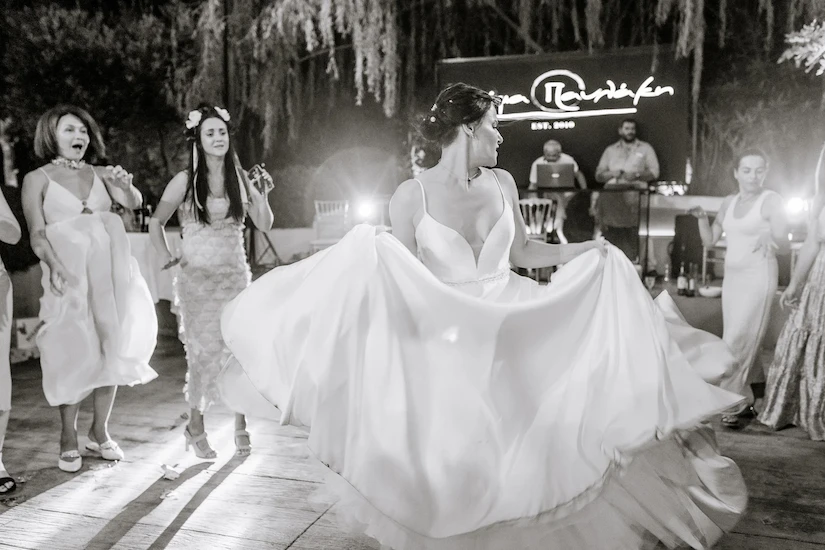
What plays at a Greek wedding, and when? You walk in to an entrance song. Dinner starts late, usually around 9pm, with modern Greek pop sitting under it. The traditional circle dances come after, and that’s when the wedding songs everybody knows get played. Then the party set takes over and runs until 3am.
I’m Greek and planned my wedding in Crete from abroad for a guest list from six continents. This article is for those who want to incorporate a bit of Greek wedding music. I touch a bit upon the types of dance you might want to incorporate as well as a researched (and admittedly biased) list of songs across specific moods during your wedding. The goal isn’t to build a Greek destination wedding, rather add in a few elements that give homage to the local music, get people people up and moving, and create memorable experiences with a hint of how the Greeks really celebrate.
One thing I never noticed until my husband started translating and understanding Greek music is how emotive it is. He pointed out that even usually stoic, quiet men, seem to become a puddle of emotion during these songs. Love is almost always the central theme. The songs carry stories. For sure they tap a nerve of nostalgia. Many of them most Greeks know and love.
For starters, five songs turn up at Greek weddings again and again: Simera Gamos Ginete, Orea Pou Ine I Nifi Mas, O Gamos Kalorizikos, Zorba the Greek and Ikariotiko. Five dances carry the night: Kalamatianos, Syrtos, Sirtaki, Hasapiko and Zeibekiko. You don’t need to know the steps, because someone will take your hand and show you. Below are my five playlists, 138 songs in the order a real Greek night runs, and you can play every one of them on this page. Ours in Crete was still going at 3am, which is why we paid 250 euros for shuttles every 30 minutes from 9pm until 2:30am.
Table of Contents
A Greek wedding night, hour by hour

Before my husband ever went to a Greek wedding, we rewatched My Big Fat Greek Wedding 1, 2 and 3. Partly for the laugh, partly so he’d know what he was walking into. The films get more right than you’d think. What they don’t give you is the clock.
Here’s the running order, and it isn’t the running order of a British or American wedding.
- Early evening. Guests arrive at the venue and start drinking while the couple is still off having photos taken. Poppy local music sits under the conversation. Nobody is dancing.
- The walk in. The couple crosses the threshold to an entrance song, which is a Greek tradition in its own right. More recently couples just choose on of their favorite songs. Ours was Radio Ga Ga by Queen, and we smashed a pomegranate in a plastic bag as we came through the gate (symbolizing an auspicious and ‘fruitful’ marriage).
- Around 9pm. Dinner. Late by British and American standards, normal here. Dinner and usually more traditional background music plays.
- Around 11pm. The dancing starts, and it starts with the circle dances, because those are the ones that pull everybody in. This is the community element. Everyone joins in!
- Just after midnight. The food comes back out. Souvlaki and pita are the standard, and you can read what actually gets served at a Greek wedding if you’re building a menu.
- Somewhere in the middle of the party. The sirtaki. It sits inside the traditional set, but a good DJ often pulls it out and saves it for the peak of the night. Ours did.
- 1am onward. The party set. This is the loudest stretch of the night and the one your guests will talk about. Greek and international pop hits play. The ones that keep you moving, dancing, and hopefully not sweating too much.
- 3am to 4am. People start to leave. Not everyone. The die hards stay on the floor and keep the party alive. The set list is almost solely Greek ballads to dance and sing along to.
We left our very first Greek wedding together at 4:30am and the floor was still packed. My husband could not believe we were among the early leavers! So when you’re pricing your night, count the hours honestly, because a party that runs past 2am is extra venue time and extra staff, and that shows up on the invoice. I’ve broken down what a Greek wedding venue actually costs separately.
How to use these five playlists
I built five playlists, one for each stretch of the night: Cocktail Hour, Dinner and Background, First Dances and Special Moments, Traditional Dancing Hour, and Party Time. 138 songs in total. Every one is on this page and you can play it right now, no email required.
One thing before the lists, because our own experience cuts against the order above. That timeline is how a Greek wedding runs in Greece, where the room is full of Greeks. Ours wasn’t. Most of our guests were not Greek, so we deliberately opened the party on non-Greek bangers to get everybody on the floor first, and brought the Greek music in once it was full. It worked, and I’d do it again, and it’s the single most useful thing I know about keeping a party going. Use the moments below as the shape of the night, not as the clock.
Which brings me to the part nobody else will tell you. These are examples, not a running order. If you’re having a destination wedding in Greece, you probably don’t want a full day and evening of Greek music, and you shouldn’t pretend otherwise to please anyone. Sit down with your partner, listen through, keep what stands out and hand the rest to your DJ. Then check one thing: that your party set carries enough solid Greek hits for everyone to dance the traditional steps to. Five to ten is plenty.
And an admission, because it’s the most useful thing I know about wedding music. We spent a lot of time on the playlist. It was the thing we worried about most, and it was the thing we needed to worry about least. A DJ who can read a room will beat a perfect list every time. Build the list anyway, because it tells your DJ who you are, then let go of it on the night. Leave it to the professional to feel and move the crowd.
Cocktail Hour: what plays while your guests arrive
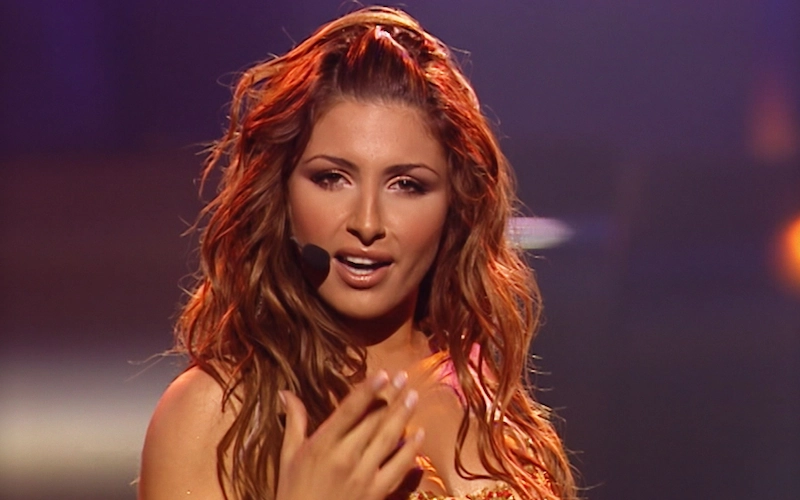
This is the hour when nobody is dancing yet. Guests are finding their table, getting a drink, working out who they know. The music has one job here: sound Greek, sound happy, stay out of the conversation.
I went modern and pop for this one. Panselinos by Despina Vandi, Zise by Nikos Vertis, Kane Mas Ti Hari by Giorgos Kakosaios, and Mystiko by Anastasia. 29 tracks in all.
Here’s the trick in it, and it’s deliberate. Two of the songs are Eurovision: My Number One by Helena Paparizou, which actually won Eurovision for Greece in 2005, and Secret Combination by Kalomira. Your British, American and Australian guests may know nothing about Greek music, and they’ll still half recognize those two. That’s a small, cheap piece of hospitality, and it costs you one slot on a list.
Dinner and Background: the music under the plates

Dinner in Greece starts around 9pm and runs long, and the music underneath it is doing something quite specific: it has to hold a room of people who are talking, eating and not yet on their feet.
So this playlist starts soft and modern and then turns. The back half is Greek rock and the singer-songwriter tradition: I Palies Agapes Pane Ston Paradiso by Pyx Lax, Fotia Sto Limani by Xilina Spathia, Ola Se Thimizoun by Haris Alexiou, Giorti by Tripes. That’s what Greeks in their thirties and forties grew up on. It plays under conversation without demanding the floor, and the Greek guests at the table will look up when it comes on.
One track to single out: Eleftheros (Part 1 – Nostalgia) by Konstantinos Argiros. It’s the one I’d bet on landing with Greek guests and non-Greek guests alike, and you can hear it here without opening the whole list.
My husband made a point about Greek music once that I’d never thought about, even though I grew up with it. The lyrics carry everything. Greek songs externalize feeling in a way that English-language pop mostly doesn’t, and that is why a dinner set here isn’t background in the way you might mean it at home. Someone at your table is listening to the words.
First Dances and Special Moments
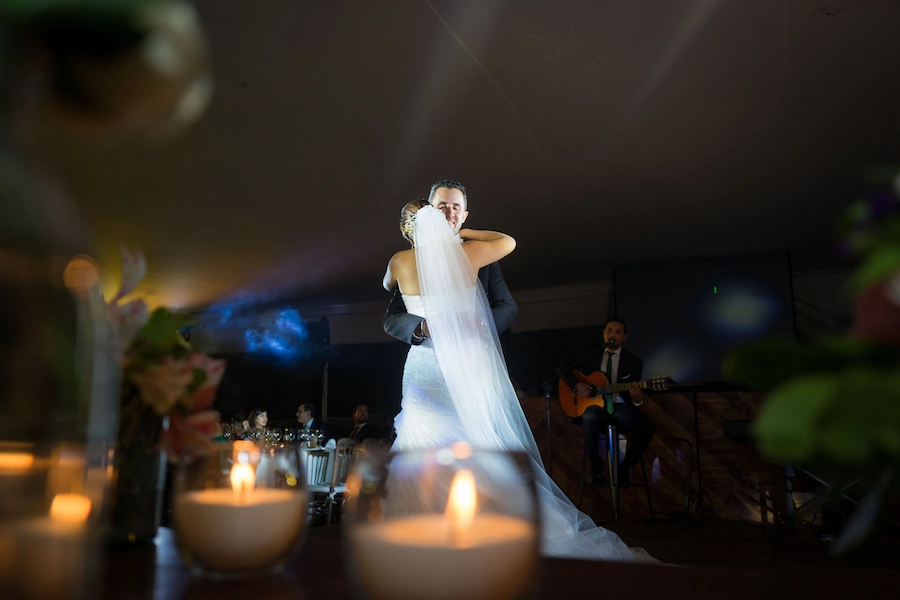
A quick honest note before the songs. A Greek first dance is often not the Anglo first dance. There isn’t always a cleared floor, a spotlight and three and a half minutes of everyone watching you. Plenty of Greek couples never do one at all, and nobody thinks it’s odd.
If you want one, this is the set I’d choose from. Tha ‘Mai Edo by Konstantinos Argiros. S’ Agapo by Alkistis Protopsalti and Antonis Remos. Otan Eho Esena by Dimitris Mitropanos. Den Eho Polla by Glykeria. 23 tracks, and they cover the other big moments too, the ones people forget to plan: the cake, a dance with a parent, the toast.
The one thing I’d say about picking a first dance in a language your guests don’t speak? Ask a Greek friend what the words actually mean before you commit. Some of the most beautiful Greek love songs are about a love that ended.
The Traditional Dancing Hour: the songs everyone actually knows
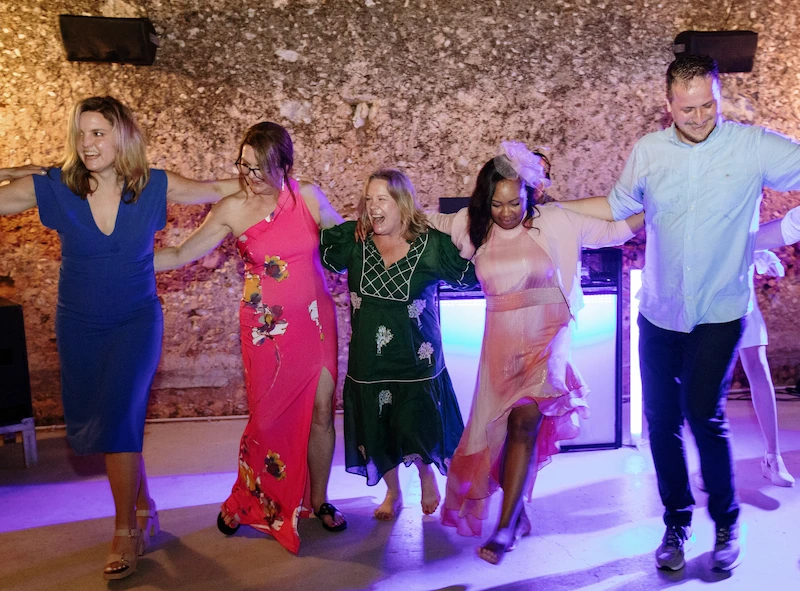
If you only listen to one of these five, make it this one. 22 tracks, and it’s the hour that makes a Greek wedding a Greek wedding.
The wedding-specific songs come first, and they’re played at fixed points, not danced to freely: Orea Pou Ine I Nifi Mas by The Greek Wedding Band and John Tsiflikis, which means “how lovely our bride is”. Simera Gamos Ginete by Sofia Kollitiri, “today a wedding is taking place”. O Gamos Kalorizikos by Dimitris Sakalis. Hronia Polla Na Zisete Nyfi Kai Gambre Mas, which is simply “long life to our bride and groom”.
Then the circle dances, and this is where your guests get pulled in: Mantili Kalamatiano, Samiotissa, Milo Mou Kokkino, Gerakina, Saranta Palikaria. Simple steps, an open circle, a leader at the front, everyone else holding on. Then Zorba The Greek for the sirtaki, Hasapiko Politiko and Xasapikos for the hasapiko, and To Zeibekiko Tis Evdokias for the moment the floor clears for one person. Ikariotiko, Frangosyriani and Mana Mou Ellas are in there too.
Ours landed somewhere in the middle of the party, as best we remember, and that was the DJ’s call rather than ours. He waited until the room was at its fullest and then put the sirtaki on. That timing is the whole skill, and it’s the single best argument for paying for someone who can read a room.
Party Time: the 1am to 3am set
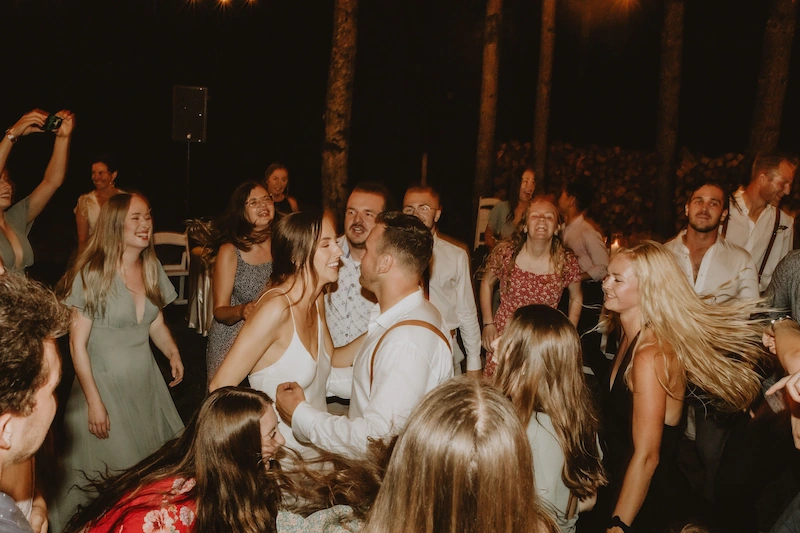
33 tracks, and this is the one your guests will remember. Tora Tora (Boro Boro) by Giorgos Mazonakis and Arash. Fuego by Eleni Foureira. Opa Opa by Notis Sfakianakis. Shake It by Sakis Rouvas. Modern Greek pop, hard, loud and built to keep a floor full at 2am.
We went through this list specifically to make sure it carried five to ten solid Greek hits that everyone can dance the traditional steps to, not just jump around to. That balance is the whole job of a party set at a Greek wedding: your international guests need something they can move to, and your Greek guests need something they can actually dance.
Two practical things that keep a floor alive at this hour, and neither is a song. First, a designated party squad, one or two people whose unofficial job is resurrecting the dance floor. We’d been dancing for two hours, sat down at our table for a minute, and watched the floor empty behind us. Our best man came over and pulled us both straight back on. Ask someone in advance. They’ll be flattered. Second, lighting. We spent 4,000 euros on it, which sounds absurd until 1am, when the room is what makes people stay.
And one trick from our bartender, which is the best value for money on this whole page. Instead of spirits we served mastiha, a Greek liqueur that’s about half the strength of a spirit. His packer was going to bring 50 shot glasses. Lefteris took one look at the two of us, decided 50 wasn’t going to cut it, and packed 300! Our guests got through 250 of them, and hardly anyone was wrecked the next morning. That’s how you get people dancing for six hours instead of sitting down at midnight. Ask your bartender what they’d pack, then trust the answer.
I built a free calculator using real vendor quotes from across Greece. Enter your guest count and preferences and it builds a full estimate, VAT included.
Simera Gamos Ginete: the words everyone sings, and what they mean
There’s a moment at almost every Greek wedding when a room full of people who don’t share a language all sing the same thing. This is the song. Simera Gamos Ginete means “today a wedding is taking place”, and it is the closest thing Greece has to a universal wedding song. Sofia Kollitiri’s version is the one in the Traditional Dancing Hour playlist above.
Listen out for something odd in the first line. The singer starts the word, breaks off, and starts the line again: “Simera ga-, simera gamos ginete”. That is not a mistake. It’s how these old folk verses are built, and once you’ve heard it you’ll hear it in every version.
Here are the three lines that matter most.
| Greek | How to say it | What it means |
|---|---|---|
| Σήμερα γάμος γίνεται σ’ ωραίο περιβόλι | Simera gamos ginete s’ oreo perivoli | Today a wedding is taking place, in a beautiful garden |
| Σήμερα αποχωρίζεται μάνα από την κόρη | Simera apohorizete mana apo tin kori | Today a mother parts from her daughter |
| Γαμπρέ μου, να την αγαπάς και να μην τη μαλώνεις | Gambre mou, na tin agapas kai na min ti malonis | Groom, love her, and don’t be harsh with her |
Read that middle line again. In the middle of the happiest song of the day, somebody is singing about a mother losing her daughter. That is very Greek, and it’s the reason your Greek mother-in-law may cry at a moment that looks, to everyone else, like the fun part. Tell your non-Greek guests what the words mean before the night. It turns a nice tune into the thing they remember.
The five Greek wedding dances, and what you actually do

Five dances carry a Greek wedding: Kalamatianos, Syrtos, Sirtaki, Hasapiko and Zeibekiko. Four of them are group dances that you can join with no practice at all. One of them is a solo and you should not join it. Here’s each one, and what a guest is supposed to do.
Kalamatianos
The one everybody can do. It’s an open circle, holding hands at shoulder height, with a leader at the right-hand end who gets to improvise while everyone else keeps the basic step. The rhythm is 7/8, counted in three uneven groups of 3, 2 and 2, and the full pattern is 12 steps across four bars of music.
What that means in practice: it sounds like it’s limping, and your feet work it out faster than your head does. Get in the circle between two Greeks, not at the end. They’ll carry you.
Syrtos
The older, slower cousin of the Kalamatianos, and often the first dance of the traditional set. Same open circle, same hand hold. The difference is the rhythm: a steady 4/4 counted slow, quick, quick, which is easier to hear than the 7/8, and again 12 steps to complete the pattern.
If you have older guests or nervous ones, this is the dance to pull them into. It’s calm enough to talk through, and nobody is going fast enough to trip anyone.
Sirtaki
This is the one every foreign guest asks for, and it is not an ancient Greek dance. It was made for the 1964 film Zorba the Greek, the choreography credited to Giorgos Provias and the music written by Mikis Theodorakis, and it was built out of the slow and fast versions of the hasapiko. Arms across your neighbors’ shoulders, in a line, starting slowly and speeding up until it falls apart.
Does that make it fake? No. It’s the one non-Greeks recognize, it gets more people on a floor than anything else on the list, and Zorba The Greek is in my Traditional Dancing Hour playlist for exactly that reason. Just know what you’re asking your DJ for.
Hasapiko
The butchers’ dance, and the ancestor of the sirtaki. A short line, not a circle, hands on the shoulders of the people either side of you, in a steady four count. The slow version is the elegant one, almost stately, and the fast version, the hasaposerviko, is the one that turns into chaos.
Hasapiko Politiko and Xasapikos are both in the traditional playlist above. It looks harder than it is, because the line moves as one thing. Copy the person on your left and you’ll be fine within a minute.
Zeibekiko
This is the one you do not join. It’s a solo, danced in 9/8, improvised on the spot, never choreographed, and the same person never dances it the same way twice. The floor clears. Everyone else kneels or crouches in a ring around the dancer and claps the rhythm.
At a wedding it’s usually a close friend or a family member dancing it in your honor, which is why interrupting is a real breach. Don’t step in unless the dancer invites you. Watch, clap, and let them have it. My husband’s whole crash course before his first Greek wedding could have been that one sentence.
Live band or DJ, and how we found ours

Book a DJ if you want the night to move, and a live band if you want the night to feel Greek in the room. We went with a DJ, and I’d do it again. Ours was a local radio DJ, well versed in both Greek and international music, and the reason he was worth the money is that he could feel where the room was and change course. He’s the one who chose the moment for the Sirtaki. We didn’t.
Here’s how we found him, and it’s the only method I trust in Greece. We asked every venue and every vendor we met for their list of preferred suppliers, the people they’d personally recommend. My rule of thumb is that when the same name keeps coming back at you unprompted, that’s your answer. Then we went and watched him work: we joined a party at a local bar where he was playing, and after that evening we decided on the spot to hire him. Do that if you can. The best wedding suppliers in Greece often have almost no online presence at all, which is how Greek wedding vendors actually work, so searching gets you the ones who are good at being found, not the ones who are good.
The things around the music cost us 4,000 euros for lighting and 250 euros for the shuttles. We take no commission from any vendor, which is also why I have no favorite to sell you. If you’re working out the booking order, I’ve written about choosing between a live band and a DJ alongside the other first bookings.
On Crete, the music is different again
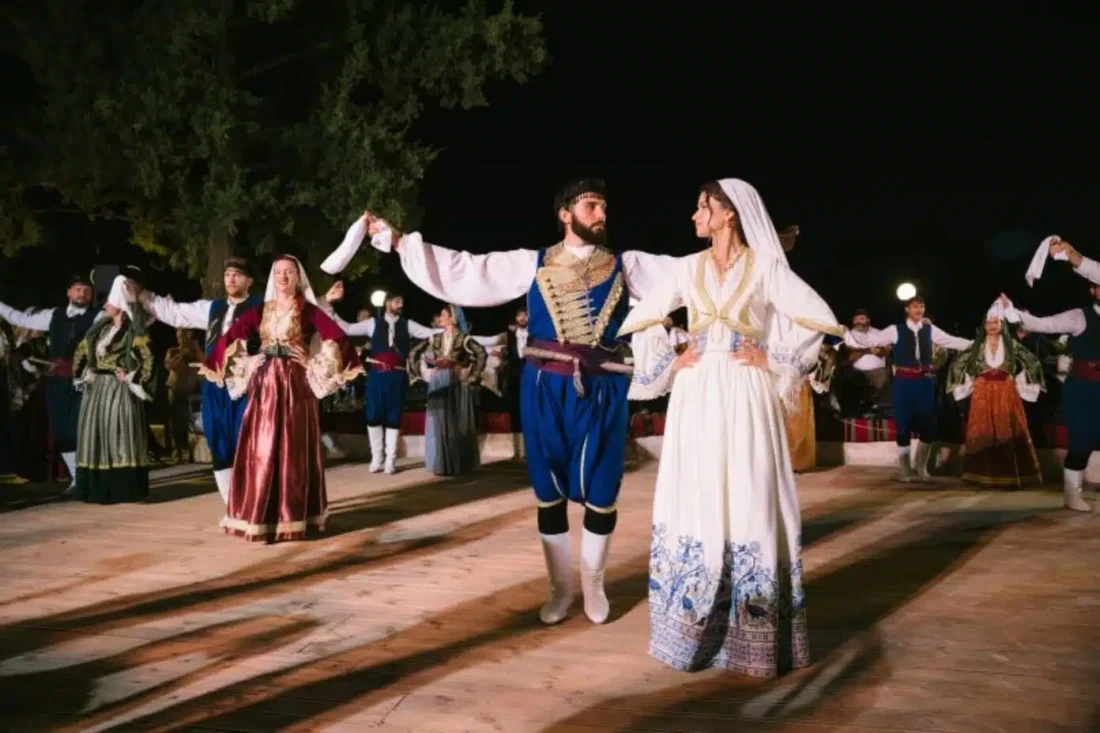
If you’re marrying on Crete, expect something that doesn’t sound like the rest of Greece. Cretan music is built around the lyra, a small three-stringed instrument played upright on the knee with a bow, and the laouto, a long-necked lute that carries the rhythm underneath it. The two are played as a pair, and they’re the standard sound at Cretan weddings and village festivals.
The other thing you’ll hear are mantinades, improvised rhyming couplets sung over the music, often composed on the spot for the couple. Nobody can hand you those in advance, which is the point.
We didn’t book Cretan musicians ourselves. If it’s what you want, ask your venue, because on Crete they’ll know exactly who to call, and there’s more in our guide to getting married in Crete.
What guests ask us about the music
Do I have to dance?
No. Nobody is counted and nobody is judged. But you’ll be asked, probably more than once, and “I don’t know how” isn’t taken as an answer, it’s taken as an invitation to teach you.
Is it rude to sit one out?
Not at all. The one exception is the Zeibekiko: stay off the floor for that one unless the dancer waves you in.
Do I need to learn the steps before I come?
Honestly, no. The circle dances exist to absorb beginners. Stand between two people who know what they’re doing, hold on, and watch the feet in front of you. Ten minutes and you’ve got it!
Do Greeks still smash plates?
Mostly no. It’s considered dated, and flowers or napkins thrown in the air have replaced it. I told my husband very clearly that we were not smashing plates at our wedding. My husband quietly rounded up some of our guests and they smashed our personalized plates outside anyway. I emailed the caterer the next week to apologize and offer to pay, and Frangiskos wrote back: it’s fine, after all we are Greek! If you want the full story, here’s why Greeks smash plates.
What if half my guests don’t speak Greek?
That’s most destination weddings in Greece, including ours. Mix the sets, tell people what the big songs mean, and make sure the traditional hour has someone in it who’ll take a stranger’s hand.
What I’d tell you about the music, a couple of years on
What I remember isn’t a song. It’s ninety-six people from six continents, most of whom had never met each other on the Monday, being pulled into a circle by strangers who didn’t share their language and didn’t need to. The Greeks paired off with our friends from the US, from Poland, from the Netherlands, and taught them the steps one to one, on the floor, in the middle of the party. Nobody stood at the edge holding a drink.
You can plan for that. Not by picking better songs, but by booking someone who can read a room, asking one friend to keep the floor alive, and telling your guests in advance that they’re going to be pulled in so they arrive expecting it. Then let it go and dance.
Build the list, hand it over, and put your phone down at 11pm.
If you’re pricing the whole night alongside your cultural research, the free cost calculator is a useful first step.
Read more articles about Greek Wedding Culture

Greek Orthodox Wedding Roles: Complete Guide to Koumbara and Koumbaro
Master Greek Orthodox wedding roles and responsibilities. Everything couples need to know about koumbara and koumbaro traditions.

Greek Wedding Traditions & Rituals: A Guide to Symbolic Customs
Discover meaningful Greek wedding traditions and rituals. Honor your heritage with symbolic customs that make your ceremony special.

How to Keep your Wedding Party Going (Without Hangovers)
Discover proven strategies to keep your Greek wedding celebration lively all night without the morning-after regrets. Expert party tips inside!
