
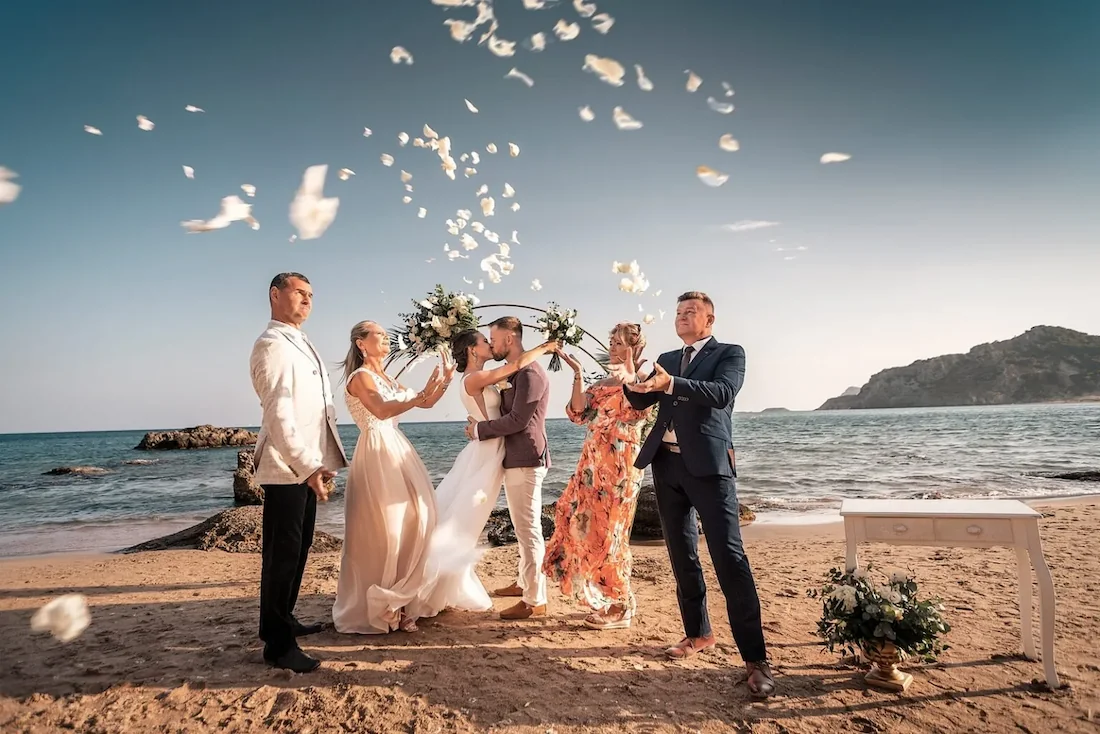
Figuring out what to wear to a wedding can feel overwhelming, especially if you’re traveling to Greece for a destination wedding. As someone who planned my own Greek wedding in Crete, I guided my international guests in everything from Orthodox church dress codes to dancing on cobblestones in 35°C heat. Some got it perfectly right. Others…well, let’s just say stilettos and marble floors don’t mix.
Whether you’re a guest wondering what to wear to a Greek wedding, or a couple planning your celebration and trying to guide your guests on appropriate Greek wedding attire, this guide covers everything you need to know. From Orthodox church requirements to climate considerations, footwear that won’t betray you on cobblestones, and cultural etiquette that’ll help you celebrate like a local. I’ve got you covered.
The truth? Greece wedding attire is about balancing three things: respecting religious traditions, staying comfortable in the Mediterranean climate, and looking elegant for one of the most photographed celebrations you’ll ever attend. Get those three right, and you’ll be dancing the Kalamatianos with confidence until 4 a.m.
Table of Contents
Quick Guide: Greek Wedding Attire Do’s & Don’ts

Before we dive deep, here’s your cheat sheet for what to wear to a Greek wedding that I wish someone had given my guests:
DO This:
Cover your shoulders and knees for Orthodox church ceremonies. This is non-negotiable. Bring a pashmina or shawl you can add for the ceremony.
Choose breathable, flowing fabrics. Think linen, cotton, silk chiffon. You’ll thank me when it’s 32°C at 3 p.m.
Wear block heels, wedges, or elegant flats. Stilettos are your enemy on cobblestones and marble.
Embrace Mediterranean colors. Blues, corals, soft golds, and pastels photograph beautifully against Greek landscapes.
Pack a light jacket or shawl. Evening temperatures drop, especially on islands with strong winds.
Bring comfortable dancing shoes. Greek wedding receptions last until dawn. Literally.
SKIP That:
Don’t wear white, cream, or ivory. These are exclusively for the bride. Even off-white is too close.
Avoid jeans or casual shorts. Even “casual” Greek weddings are more formal than you think.
Don’t assume bare shoulders are fine. They’re never appropriate inside Orthodox churches.
Avoid wearing stiletto heels. Unless you want to spend the night hobbling or stuck between cobblestones.
Don’t forget a wrap or jacket. Island winds and evening temperatures will catch you off guard.
Don’t skip the dress code conversation. If you’re planning a Greek wedding, be explicit with your guests about expectations.
Understanding Greek Wedding Dress Codes

The Formality Spectrum
Greek wedding attire expectations sit somewhere between “Mediterranean relaxed” and “formal celebration.” This can be confusing for international guests. Here’s what I learned from hosting 100 guests at my own Greek wedding:
Religious Ceremony: Always formal, always modest. Think of it like attending a sacred service (because you are). This isn’t the time for beachy casual or revealing styles.
Civil Ceremony: Slightly more relaxed but still elegant. Business casual at minimum, cocktail attire preferred.
Reception: Formality varies by venue. Beach taverna? Smart dressy casual. Hotel ballroom? Cocktail to formal. Cliffside sunset venue? Elevated elegant.
The key insight? Greek wedding clothes should be more formal than you’d wear to a similar event at home. Greeks celebrate weddings as major life events, and attire reflects that importance.
What Makes Greek Weddings Different
Unlike many Western weddings, Greek celebrations often involve:
- Multiple locations (church ceremony → photo location → reception)
- Extended timeline (ceremonies starting at 6 p.m., receptions until 4-6 a.m.)
- Varied terrain (historic churches, outdoor venues, dance floors)
- Religious requirements that are strictly enforced
- Climate extremes (hot days, cool evenings, strong winds)
Your Greece wedding outfit needs to work across all these scenarios.
Orthodox Church Requirements: What You Must Know

This is where I see the most confusion—and honestly, where getting it wrong is most visible. Let me be direct about what to wear to orthodox church ceremonies:
Non-Negotiable Rules for Women:
Shoulders SHOULD be covered. Not even with a beautiful strapless dress. You’ll need a shawl, bolero, or jacket that stays on for the entire ceremony. Some Priests are flexible on this (as was the case with our outdoor church ceremony) but it’s best to err on the side of caution.
Knee-length or longer. Your dress or skirt must hit at least your knees. If you’re between sizes, go longer. Standing for 45-60 minutes means fabric shifts.
Modest necklines. Low-cut or plunging necklines aren’t appropriate. Think elegant, not revealing.
No bare backs. Open-back dresses need coverage for church.
For Men:
Long trousers required. No shorts, no matter how hot it is or how casual the wedding feels.
Collared shirt minimum. Button-down shirts are expected. T-shirts aren’t appropriate.
Jacket and tie for formal weddings. You can usually remove them for the reception, but wear them for the ceremony.
The Head Covering Question
Here’s what creates confusion: Some very traditional Greek Orthodox churches or monasteries expect women to cover their heads. However, this is NOT standard for most weddings. At my wedding in Crete, none of my female guests covered their heads, and it was completely appropriate.
The rule: Covered shoulders are universal and advised. Head coverings are optional unless specifically requested by the couple or church.
What Happens If You Don’t Comply?
I’ve seen it happen. A guest arrived at a Greek Orthodox church in a strapless dress with no cover-up. The church staff offered her a shawl (thankfully), but the embarrassment was real. Some stricter churches may not allow entry without proper coverage.
Don’t risk it. Pack appropriate coverage.
Climate Reality: Dressing for Greek Weather

Let me tell you what the guidebooks don’t: Greece is HOT during wedding season, the wind is stronger than you expect, and evening temperature drops are real. Your Greek wedding attire needs to account for all of it.
Summer Weddings (June-September)
Daytime Reality: 28-35°C (82-95°F). I watched my August wedding guests wilt during outdoor photos. Learn from their mistakes.
What Works:
- Lightweight linen or cotton dresses
- Breathable silk or chiffon for women
- Linen suits for men (NOT wool)
- Light colors that reflect sun
- Loose, flowing silhouettes
What Doesn’t:
- Heavy fabrics or structured dresses
- Dark colors that absorb heat
- Anything requiring shapewear in this heat
- Non-breathable synthetic fabrics
The Island Wind Factor: Santorini, Mykonos, and Paros experience strong Meltemi winds in July and August. I’m talking 30-40 km/h sustained winds with gusts over 70 km/h. Flowy maxi dresses become parachutes. Updos are essential. Weighted hems are your friend.
Spring/Fall Weddings (April-May, October-November)
Temperature Range: 18-25°C (64-77°F) days, 12-16°C (54-61°F) evenings
Layering Strategy:
- Medium-weight dresses with light jackets
- Pashminas that serve double duty (church coverage + warmth)
- Light blazers for men
- Closed-toe shoes become practical
Weather Unpredictability: Spring and fall bring occasional rain. Pack a stylish option that works if weather turns.
The Evening Temperature Drop
This catches everyone off guard. That beautiful warm afternoon? By 10 p.m., you’ll want coverage. Every single guest who skipped bringing a wrap regretted it at my wedding.
Solution: A versatile pashmina or light jacket that complements your outfit and works for:
- Church shoulder coverage
- Evening warmth
- Protection from wind
- Emergency sun coverage during outdoor photos
For more on seasonal Greek wedding planning, read more here.
Women’s Greek Wedding Outfits: Complete Guide

The Perfect Greece Wedding Outfit Formula
After watching what worked (and what didn’t) at my wedding and countless Greek celebrations, here’s the winning combination for Greece wedding attire for women:
Base: Flowing midi or maxi dress in breathable fabric
Coverage: Elegant pashmina or structured shawl
Footwear: Block heels (2-3 inches max) or sophisticated flat sandals
Accessories: Minimal gold jewelry, small crossbody bag
Dress Styles That Work Beautifully
Flowing Maxi Dresses: Perfect for beach or garden venues. Choose lightweight fabrics that photograph well in motion. Avoid anything with a train that’ll get destroyed on sand or dusty paths.
Elegant Midi Dresses: Versatile for any venue. The midi length is practical for varied terrain while still looking polished.
Sophisticated Jumpsuits: An excellent modern alternative. Choose elegant fabrics and cuts. Bonus: no worrying about dress lengths or wind.
Grecian-Inspired Guest Dresses: Flowing styles with gentle draping work beautifully in the setting. Just avoid looking too bridal, that’s a common mistake I see.
Fabrics That Survive the Journey
Your Greece wedding dress guest outfit needs to:
- Travel well (wrinkle-resistant or easy to steam)
- Breathe in heat
- Photograph beautifully
- Last through 8+ hours of celebration
Best Choices:
- Silk or silk blends (travel well, drape beautifully)
- Quality cotton (breathable, comfortable)
- Linen blends (less wrinkly than pure linen)
- Lightweight chiffon (elegant and cool)
Avoid:
- Heavy brocades or thick fabrics
- Anything requiring extensive pressing
- Polyester that doesn’t breathe
- Delicate fabrics that stain easily
What About Bare Shoulders?
Here’s the strategy: Choose a dress you love with a beautiful shawl or jacket. Wear the coverage for the church ceremony (45-60 minutes), then remove it for the reception. This gives you flexibility while respecting requirements.
Smart Options:
- Sleeveless dress + elegant bolero
- Strapless gown + structured shawl
- One-shoulder dress (one shoulder covered) + light wrap for the other
- Cap sleeve dress (often sufficient coverage)
Men’s Greek Wedding Attire: From Ceremony to Reception

The Suit Question
Gentlemen, I know you’re wondering: Do I really need a suit for a beach wedding in Greece? Let me give you the Mediterranean perspective.
For Orthodox Church Ceremonies: Yes, at least a suit jacket and slacks. Greek Orthodox ceremonies are formal religious services. Showing up without a jacket is like attending Sunday service in board shorts.
For the Reception: Depends on the venue and what the couple specifies. You can often lose the tie and jacket once the party starts.
Greece Wedding Attire for Men by Temperature
Summer Weddings:
- Lightweight linen or cotton suit
- Light colors (beige, light grey, light blue, tan)
- Breathable cotton button-down shirt
- Skip the undershirt if it’s very hot
- Loafers or lightweight dress shoes
Spring/Fall Weddings:
- Medium-weight suit (still avoid heavy wool)
- Darker colors acceptable (navy, charcoal, dark grey)
- Long-sleeve dress shirt
- Tie for ceremony, optional for reception
The Smart Casual Trap
If the couple says “smart casual,” don’t interpret this as jeans and a polo. In Greece, this means:
- Dress pants or quality chinos
- Button-down shirt (long or short sleeve)
- Leather shoes or loafers
- Optional: sport coat or blazer
Think “business casual elevated for a celebration.”
Greek Wedding Clothes That Keep You Cool
As someone who watched male guests suffer in summer suits, learn from their mistakes:
Cooling Strategies:
- Linen suit (wrinkles are expected and acceptable)
- Cotton-linen blend
- Unlined or half-lined jacket
- Light-colored fabrics reflect heat
- Remove jacket for outdoor photos (keep it for ceremony and formal moments)
What to Skip:
- Heavy wool suits in summer (you’ll overheat)
- Dark colors in peak heat
- Skinny-fit suits (less airflow)
- Synthetic fabrics that don’t breathe
Footwear That Survives Cobblestones and Dancing


This is where preparation meets reality. I cannot stress this enough: Greek wedding outfits live or die by footwear choices.
The Cobblestone Reality
Historic Greek churches, traditional villages, and old town venues mean cobblestones. Ancient, uneven, marble or stone cobblestones. I watched multiple guests twist ankles or spend the evening walking on grass to avoid paths.
For Women – What Actually Works:
Block Heels (2-3 inches): Provide height and elegance while offering stability. Look for wider heel bases.
Wedges: Even better for stability. Espadrille wedges fit the Mediterranean aesthetic perfectly.
Elegant Flat Sandals: Embellished or metallic flats can look incredibly sophisticated. No one will judge you for prioritizing comfort.
Platform Sandals: Give height without the instability of stilettos.
What Doesn’t Work:
- Stilettos (you’ll sink into sand, get stuck in cobblestones, slip on marble)
- Kitten heels (not stable enough for uneven surfaces)
- New shoes (you’ll get blisters during the long celebration)
The Two-Shoe Strategy
Here’s what smart guests do: Bring two pairs.
Pair 1: Comfortable, venue-appropriate shoes for the ceremony and early reception
Pair 2: Cushioned flats or sandals for serious dancing
At my wedding, guests who brought backup shoes were still dancing at 4 a.m. Those who didn’t had abandoned their shoes by midnight. Personally, I had elegantly bedazzled flat sandals I switched to for the reception.
For Men – Greek Wedding Attire Footwear

Best Choices:
- Quality leather loafers
- Dress shoes with rubber soles (better traction than leather soles)
- Derby or Oxford styles in breathable leather
Avoid:
- Brand new leather soles (too slippery on marble)
- Dress shoes that haven’t been broken in
- Canvas or casual shoes (even for beach weddings)
Beach Wedding Footwear Exception
For beach ceremonies, the couple will usually tell guests whether shoes are required. Many Greek beach weddings are barefoot for the ceremony, with shoes for the reception. Bring elegant sandals you can slip on easily.
Color Palette: What to Wear (and What to Avoid)

The Non-Negotiable: Avoid White
This is universal, but I still see guests miss it: Don’t wear white, cream, ivory, or off-white to Greek weddings. Even if it’s a white dress with a print. Even if it’s a white suit. Just no.
In Greek culture, these colors belong exclusively to the bride. Wearing white is incredibly disrespectful and will be noticed.
Colors That Photograph Beautifully in Greece
The Mediterranean setting is your backdrop. Choose colors that complement rather than compete:
Jewel Tones: Emerald green, sapphire blue, deep coral
Ocean-Inspired: Various shades of blue (from sky to navy)
Sunset Palette: Coral, peach, soft pink, terracotta
Metallics: Gold, bronze, champagne (especially for evening)
Earth Tones: Sage green, warm beige, soft terracotta
Classic Elegance: Navy, deep burgundy, forest green
The Black Question
Is black acceptable at Greek weddings? This has evolved. Traditionally, black was associated with mourning. Today, especially for evening or formal weddings, black is generally acceptable if styled elegantly with celebratory accessories.
Modern Rule: Black is fine for evening receptions at formal venues. Add colorful jewelry, a bright pashmina, or metallic accessories to lift the look and show celebration.
Skip black for: Daytime beach weddings, very traditional family celebrations, or if the couple specifically requests colorful attire.
For Couples Planning: Setting Color Guidance
If you want your wedding photos to have a cohesive aesthetic, it’s completely appropriate to provide color guidance:
On Your Website: “We’d love to see our guests in Mediterranean-inspired colors! Think ocean blues, soft corals, golden tones, and sage greens. Please avoid white, cream, and ivory.”
What NOT to do: Require specific colors or overly restrict choices. Guests shouldn’t feel like they’re in your wedding party.
Outfit Ideas by Venue Type

Your Greek wedding attire should match the venue’s vibe and practical demands.
Beach Ceremony
For Women:
- Flowing maxi dress in lightweight fabric
- Wedge espadrilles or elegant flat sandals
- Hair secured (wind!)
- Minimal jewelry
For Men:
- Linen suit in light color
- No tie if the couple says it’s optional
- Loafers (remove shoes for beach ceremony if desired)
Avoid: Structured dresses, stilettos, anything that can’t handle sand
Historic Church + Traditional Venue
For Women:
- Elegant midi or maxi dress with shoulder coverage
- Block heels or dressy flats
- Classic jewelry
- Structured shawl or bolero
For Men:
- Full suit with tie
- Dress shoes
- Traditional styling
Avoid: Overly casual interpretations, revealing styles
Cliffside/Santorini Venue
For Women:
- Romantic, flowing dresses
- Secure hairstyle (wind is serious here)
- Wedges or block heels for safety on steps
- Wrap for evening
For Men:
- Light-colored suit
- Be prepared to remove jacket for photos
- Secure tie (wind!)
Avoid: Anything that catches too much wind, delicate fabrics
Vineyard Wedding
For Women:
- Floral prints or earth tones work beautifully
- Block heels or wedges (grass and gravel)
- Garden-party elegant
- Pashmina for evening
For Men:
- Suit in any color
- Dress shoes with grip
- Smart casual if specified
Avoid: Stilettos that sink in grass
Urban Rooftop (Athens)
For Women:
- Sophisticated cocktail attire
- Sleek silhouettes
- Statement jewelry
- Heels are practical on solid surfaces
For Men:
- Dark suit
- Polished dress shoes
- Contemporary styling
Avoid: Overly casual beach vibes
Packing Tips for Destination Wedding Guests

The Capsule Wardrobe Approach
Most destination wedding guests will need outfits for:
- Welcome dinner/drinks (Day 1)
- Wedding ceremony and reception (Day 2)
- Post-wedding brunch or beach day (Day 3)
Here’s how to pack smart for Greece wedding attire needs:
Day 1: Welcome Event
Women: Sundress or smart jumpsuit, comfortable sandals, light cardigan
Men: Chinos and button-down, loafers, optional blazer
Day 2: Wedding
Women: Main dress + coverage option, block heels, dancing flats, pashmina, clutch
Men: Suit, dress shoes, casual shoes for after-party
Day 3: Casual
Women: Maxi dress or linen outfit, flat sandals
Men: Smart shorts or casual pants, polo or casual shirt
Packing Strategies
Use a Garment Bag: Carry your main wedding outfit in a garment bag if possible. This minimizes wrinkles.
Choose Wrinkle-Resistant Fabrics: Silk blends, quality jersey, and modern technical fabrics travel better than pure linen or cotton.
Pack Your Shoes Strategically: Stuff shoes with socks or small items. Place heavier shoes at the bottom of your luggage.
Bring a Small Steamer: Many hotels have irons, but a travel steamer is lighter and easier for delicate fabrics.
Emergency Kit:
- Fashion tape (for coverage adjustments)
- Safety pins
- Stain remover pen
- Blister bandages
- Small sewing kit
What to Carry on the Plane
Your wedding outfit should be carry-on if at all possible. Lost luggage and weddings don’t mix. I’ve seen too many panicked guests resort to last-minute Athens shopping.
Carry-on essentials:
- Main outfit (or at minimum, your dress/suit)
- Shoes for ceremony
- Essential accessories
- Any required medications
For Couples: Setting the Right Dress Code

If you’re planning a Greek wedding, clear communication about Greek wedding attire expectations saves everyone stress. Read on further here how to make guests feel at home before the wedding.
What to Include on Your Wedding Website
Do Include:
- Specific dress code level (formal, cocktail, smart casual)
- Climate warnings (“It will be very hot, dress accordingly!”)
- Venue terrain notes (“We’ll be on cobblestones and grass”)
- Orthodox church requirements if applicable
- Color guidance (what to avoid, what photographs well)
Example Text: “Our wedding will include a Greek Orthodox ceremony (shoulder coverage and knee-length dresses required) followed by an outdoor reception at [Venue]. July in Santorini means hot days and cool, windy evenings. We recommend cocktail attire in breathable fabrics, comfortable footwear for dancing on stone terraces, and a wrap for the evening. Please avoid white, cream, and ivory—those are for the bride! We’d love to see Mediterranean-inspired colors like blues, corals, and soft golds.”
Additionally we featured images of a mood board with dresses and suits to inspire guests on our wedding website. We weren’t prescriptive but this way we could guide them in a helpful direction.
Dress Code Categories Explained
Formal/Black Tie:
- Women: Floor-length gowns
- Men: Dark suits or tuxedos
Cocktail:
- Women: Knee to floor-length dresses
- Men: Suits
Smart Casual:
- Women: Sundresses, elegant separates
- Men: Dress pants, button-down shirts, optional jacket
Mediterranean Casual:
- Women: Flowing dresses, elegant resort wear
- Men: Linen pants, casual button-downs
If you’re the bride searching for your perfect dress, explore our complete guide to Greek goddess & Grecian wedding dresses.
What About Greek Traditional Attire?
Some couples ask whether Greek guests or family will wear traditional Greek clothing. For most modern Greek weddings, traditional folk costumes are not worn. However, you might see:
- Older generations in more conservative, formal attire
- Greek grandmothers in elegant dark dresses
- Traditional music and dancing (but not traditional costumes)
If your Greek family IS planning to wear traditional attire, give international guests a heads-up so they understand the cultural element.
The Guest Handbook Approach
Consider creating a simple one-page PDF with:
- Dress code summary
- Climate expectations
- Venue terrain
- Orthodox church requirements
- Color palette suggestions
- Packing checklist
Email this to guests 2-3 months before the wedding. Many folks will relish shopping an picking out their outfits early on.
Cultural Etiquette and Reception Tips

Understanding Greek wedding clothes is just part of fitting in. Here’s what else to know:
Gift Giving
Money is the traditional and expected gift at Greek weddings. It’s given in an envelope to the couple, typically at the reception. While amounts vary, a general modern guideline is €100-€150 per person for close friends/family.
Reception Traditions
Greek Dancing: You’ll be invited to join circle dances like the Kalamatianos. Don’t be shy—everyone joins in, and it’s expected. Your comfortable shoes will matter here.
Late Night Culture: Greek weddings regularly continue until 4-6 a.m. This isn’t an exaggeration. Pace yourself.
Plate Smashing: While famous, this is now rare at weddings due to safety concerns and venue restrictions. Don’t expect it or be disappointed if it doesn’t happen. My husband wrote a feature on Greek plate smashing at our wedding here.
For more on Greek wedding traditions accessible for anyone, read on in my Greek Wedding Traditions guide.
What to Talk About (and What to Avoid)
Great Conversation Topics:
- The beautiful ceremony
- How wonderful the couple looks
- Your experience visiting Greece
- Greek food and culture (positively!)
Avoid:
- Greek economic crisis or politics
- Comparisons to “My Big Fat Greek Wedding” (Greeks are tired of this reference)
- Assumptions about Greek culture based on stereotypes
The Toast Custom
Greeks toast with “Na zisete!” (NAH zee-SEH-teh) which means “May you live!” or “To life!” Learn this phrase, you’ll use it frequently.
Conclusion: Celebrating with Confidence

Planning what to wear to a Greek wedding doesn’t have to be stressful. Remember the three core principles: respect Orthodox requirements with proper coverage, dress for the Mediterranean climate in breathable fabrics, and choose practical footwear that handles cobblestones and dancing.
Whether you’re a guest preparing for a destination celebration or a couple guiding your international guests, clear communication about Greek wedding attire expectations makes everything smoother. When guests feel confident and comfortable in their outfits, they celebrate more freely—and that’s what Greek weddings are all about.
From personal experience hosting international guests at my own Greek wedding in Crete, the guests who had the best time were those who came prepared: modest but elegant outfits, comfortable shoes, layers for temperature changes, and open hearts ready to dance until dawn.
For Guests: Use this guide to prepare your outfits, pack smart, and arrive ready to celebrate one of the most vibrant, joyful wedding traditions you’ll ever experience.
For Couples: Share relevant sections with your guests. Your clear guidance helps them feel confident and ensures your vision for the celebration comes to life.
And most importantly? Once you’ve got your outfit sorted, let go of the stress and prepare for an unforgettable celebration. Greek weddings are about love, family, incredible food, endless dancing, and joy that lasts until sunrise. With the right Greece wedding attire, you’ll be ready for all of it.
Kalí diaskédasi! (Have fun!)
Curious how much your complete wedding in Greece would cost?
I built a free calculator using real vendor quotes from across Greece. Enter your guest count and preferences and it builds a full estimate, VAT included.
Related Articles
Ready to dive deeper into Greek wedding planning?
Planning Your Greek Goddess Wedding Look Are you the bride? Discover how to achieve that divine goddess aesthetic with our complete guide to Greek goddess wedding dresses, featuring designer options, styling tips, and ancient inspiration for modern brides.
Understanding Greek Orthodox Wedding Traditions anyone can adopt. Learn about the beautiful symbolism behind Greek Orthodox ceremonies, from the stefana (wedding crowns) to the ceremonial dances, so you can fully appreciate and participate in these meaningful traditions.
Complete Guide to Greek Wedding Costs. Planning your own destination wedding in Greece? Our comprehensive cost breakdown by island helps you budget realistically for venues, vendors, and all the details that make Greek weddings magical.
FAQ: Greek Wedding Attire Questions Answered
General Greek Wedding Attire Questions
For women, wear a modest dress that covers shoulders (at least for the Orthodox ceremony) and reaches knee-length or longer. Choose breathable fabrics like cotton, linen, or silk in colors like blues, corals, or soft golds. For men, wear a suit with dress shoes for the ceremony, though you may be able to dress down slightly for the reception. Always pack comfortable shoes for dancing.
Never wear white, cream, ivory, or off-white—these colors are exclusively for the bride. Avoid jeans, shorts, t-shirts, or overly casual clothing. Don’t wear stiletto heels (cobblestones!), strapless or very revealing dresses for church ceremonies, or heavy fabrics in summer heat.
Smart casual at a Greek wedding means: for women, elegant sundresses or dressy separates (not jeans); for men, dress pants or quality chinos with button-down shirts and optional sport coat. This is more elevated than typical “casual” and closer to business casual. When in doubt, dress up rather than down—Greek culture values formal presentation at celebrations.
Greek Orthodox Church Dress Code
Women should cover their shoulders and wear dresses or skirts at least knee-length. Bring a pashmina, shawl, or jacket. Men need long trousers and a collared shirt minimum, with a full suit and tie recommended for formal weddings. Head coverings for women are usually optional for weddings, though some very traditional churches may require them.
Follow the same dress code as everyone else: shoulders covered and knee-length or longer hemlines for women, suits for men. You’re not expected to wear traditional Greek attire—modern cocktail or formal attire in respectful cuts and colors is perfect. Focus on modesty for the ceremony and elegance throughout.
Colors & Style Guidelines
Yes, black is now generally acceptable at Greek weddings, especially for evening or formal celebrations. Style it with celebratory accessories—colorful jewelry, metallic shoes, or a bright clutch—to show you’re there to celebrate. Avoid black for daytime beach weddings or very traditional family celebrations.
Mediterranean-inspired colors photograph beautifully in Greece: ocean blues (sky to navy), corals, peaches, soft pinks, sage green, gold and bronze metallics, and jewel tones. These complement the landscape and lighting. Avoid white, cream, and ivory which are reserved for the bride.
Climate & Venue-Specific Questions
For summer Greek weddings (June-September), choose lightweight, breathable fabrics like linen, cotton, or silk chiffon. Women should opt for flowing dresses in light colors with a pashmina for church coverage. Men need lightweight linen or cotton suits in light colors. Everyone should bring comfortable footwear and evening coverage as temperatures can drop.
Yes, more formal than you might expect. Greek beach weddings still typically require cocktail attire. Women wear flowing midi or maxi dresses with wedges or elegant sandals. Men wear linen suits in light colors. Even “casual” Greek weddings lean more formal than similar events in other countries.
Footwear & Practical Considerations
Women should wear block heels (2-3 inches), wedges, or elegant flat sandals—avoid stilettos which are impractical on cobblestones, marble, and outdoor venues. Men should wear leather loafers or dress shoes with rubber soles for better traction. Bring a second pair of comfortable shoes for dancing, as Greek receptions last until early morning.
Pack your main wedding outfit in a carry-on garment bag if possible. Choose wrinkle-resistant fabrics and bring a travel steamer. Include: main outfit, church coverage (pashmina/shawl), ceremony shoes, dancing flats, light jacket for evening, emergency fashion tape and safety pins. Plan for 2-3 days of events including welcome dinner and post-wedding brunch.
