

Last updated: 27 October 2026.
How I know this: I planned our own Greek Orthodox wedding in Chania, Crete, in May 2024, from abroad, for 96 guests from six continents. Now I help couples plan theirs through Big Fat Greek Day, which is on track for around 45,000 visits a year.
The meltemi is the strong northerly summer wind of the Aegean, strongest in July and August and hardest on the Cyclades. You can have a windy Greek island wedding: anchor your decor, put candles under glass and start the ceremony in the evening.
Nearly everyone assumed we’d marry in high summer. We chose a long weekend in May instead. It coincided with one of the long weekends in the Netherlands, the island was going to be calmer, the sea would be warm enough for people to swim, and the costs would be lower. The week of our wedding sat in the mid-twenties, and nobody melted through the ceremony.
Peak summer is a different story. In a heatwave it can hit 40°C, and I’ve felt how heavy the air can be in some parts of Greece. Heat and wind are the two things a Pinterest board never shows, and both are completely plannable once you know they’re coming.
Greek wind cuts both ways. I’m lucky to know many of the photographers who travel across Greece for weddings every spring, summer and autumn, and they tell me two things: plan around the wind, and don’t fear it. On Crete in midsummer, the breeze is a gift. It cools everyone down and keeps the evening light and easy, even on a hot day. On Corfu, there’s often barely a breath of wind, and the still air makes a hot day feel hotter. That’s part of why Crete works so well for a midsummer wedding compared with some of the other islands.
Table of Contents
What is the meltemi wind, and when does it blow?

The meltemi is a dry northerly wind that blows across the Aegean in summer, mainly in July and August, and it hits the Cyclades hardest: Santorini, Mykonos, Paros, Naxos and Ios. On a meltemi day it can blow at 30 to 40 km/h for long stretches. On its strongest days it reaches gale force: on 13 August 2026 the National Observatory of Athens reported force 8 winds in parts of the Cyclades, which is 62 to 74 km/h before you count the gusts.
It usually blows hardest around the middle of the day and eases toward night. A study of the Aegean’s summer winds puts a typical meltemi at about 27 km/h at noon, falling below 18 km/h by midnight. That’s one more reason Greek summer ceremonies start in the evening.
The wind has a good side, too. It keeps the islands it hits cooler. Naxos, the windiest place in the Greek weather service’s August table, has an average August high of 27°C. Sheltered Corfu averages 31.5°C.
If you’re marrying on the sand, my beach weddings in Greece article has more on working with the wind at the water’s edge.
Which Greek islands are windiest in August, and is Santorini one of them?
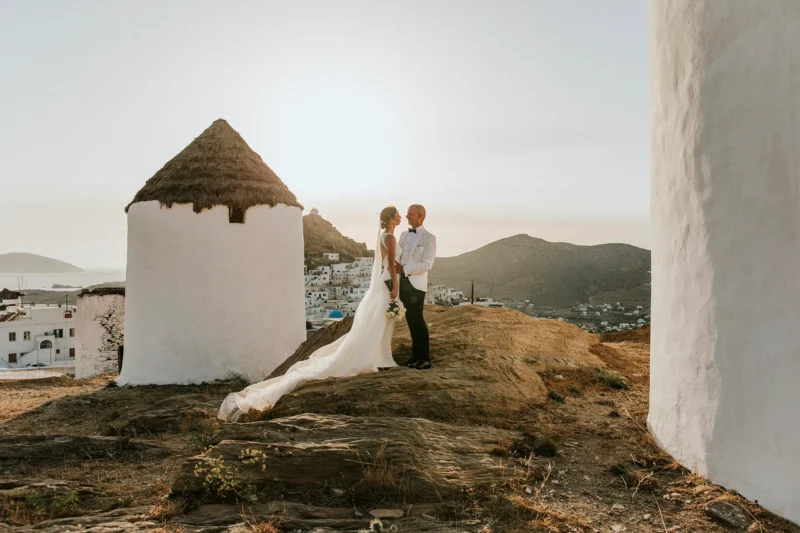
Of the places the Greek national weather service measures, Naxos gets the most wind in August, and Corfu the least of the islands. Santorini and Mykonos have no station in its table, but they’re Cycladic islands like Naxos, and the meltemi is strongest across the Cyclades, so yes, plan for wind on both.
| Place and average August wind | What it means for your decor |
|---|---|
| Naxos: 26 km/h | Loose paper lifts: menus, place cards and napkins need holding down |
| Rhodes: 21 km/h | The same band as Naxos: loose paper lifts |
| Heraklion, Crete: 17 km/h | Light flags stand out: ribbons, light fabric and long veils keep moving |
| Athens coast: 14 km/h | The same band as Heraklion |
| Chania, Crete: 12 km/h | A breeze you feel on your face, leaves rustle |
| Kalamata: 11 km/h | A breeze you feel on your face |
| Kefalonia: 11 km/h | A breeze you feel on your face |
| Corfu: 7 km/h | A breeze on your face, the lightest on this table |
These are long-term August averages at each weather station, across every hour of the month, calm nights included. A meltemi afternoon blows much harder than this, and plenty of evenings blow less. The decor column uses the Beaufort scale’s description of what wind at that speed does on land.
Naxos averages almost four times Corfu’s wind, and Chania, where we married, gets less than half of Naxos’s. So if a still, candlelit evening is the heart of your board, that alone might help you choose where to marry.
How do you keep wedding decor steady in the meltemi?

Treat everything light as something to hold, weight or shelter, and ask each supplier what happens to their piece if the wind picks up.
Candles
Open flames and a Cycladic breeze don’t mix. If candles are part of your look, put them inside hurricane glass tall enough to shelter the flame, and ask your venue whether they’ve seen candles stay lit on that exact terrace in August.
If wind is likely, ask your lighting team about battery candles and string lights, so your tables don’t depend on a flame staying lit.
Veils and hair
A long, floaty veil catches a meltemi gust the way a sail does. If your heart is set on one, plan for it:
- Ask your photographer where the most sheltered spot is for veil photos, and when the wind usually drops.
- Have someone ready to help gather it during the ceremony.
- Consider taking it off for the reception, when you’ll be moving and dancing.
- Ask your hairstylist for a style that holds in wind. An updo stays put far better than loose waves.
Arches, installations and the ceremony set-up
In Greece, ask one question about any installation: how is it anchored?
- Ask your florist how the arch is built and fixed down, and whether they’ve set it up outdoors in wind before. Look for proper weights, not only sandbags.
- Ask to see photos from a real wedding they did on a windy day, not a styled shoot.
- Agree what happens if the wind picks up on the day. A shorter, heavier design may be the smarter version of the same look.
- Make sure the ceremony microphones have wind guards.
Tables, linens and paper
On a Naxos-average August evening, loose paper lifts. Menus, place cards and seating signs need a stand, a holder or a frame rather than lying flat or propped against a glass, and tablecloth clips stop the edges lifting. Ask your venue which cloths, napkins and holders they use when the meltemi is up, and build your table look around what already works on their terrace.
Still not sure what to actually book first?
In one hour on a call, I’ll help you map what to book and in what order, with no vendor commissions. You keep the whole plan in writing.
Founding rate, 15% off. Full refund if the hour doesn’t give you a clear way forward.
How do you plan a Greek wedding for 40°C heat?
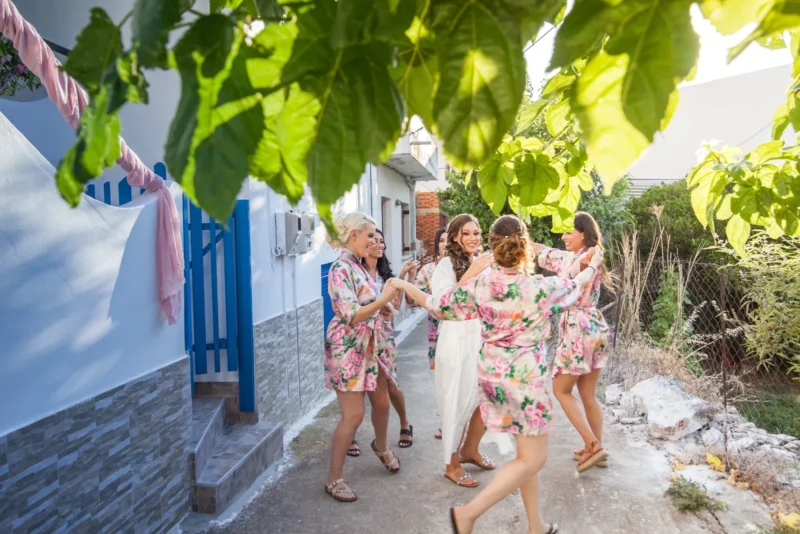
Start late and shade your guests. In a heatwave, peak summer in Greece can hit 40°C, even though the average August high is closer to 27°C on Naxos and about 30°C in Chania. A few things to plan:
- Go late. Summer ceremonies usually start in the evening. In Crete, 19:00 to 20:00 is normal for a church or symbolic ceremony in July and August, once the worst of the heat has passed. It’s better for the flowers and far better for your guests.
- Plan shade and water for anyone waiting outside.
My flowers article goes deeper on what’s in season and what it costs: wedding flowers in Greece. And for what your guests should pack for heat and wind, there’s my article on what guests should wear to a Greek wedding.
What if it rains on an October wedding in Greece?

Have a covered plan B you’ve seen with your own eyes, especially on the Ionian side, where October is noticeably wetter than September. Corfu averages about 140 mm of October rain over around 11 days, more than three times the October rain on Naxos. October has a lot going for it, and my best time to get married in Greece article explains why, but for an open-air October wedding, ask your venue:
- What’s the covered plan B, and can I see it?
- Has it ever been used, and how did that wedding look?
- When do we decide to switch, and who makes the call?
Walk through the plan B on your venue visit, not just in a photo, and agree the decision time before the wedding week.
Which month is kindest to candles and floaty fabric?

If your board is all tall candles and floaty fabric, May or June will be far kinder to it than July and August in the Cyclades. Choosing the month is its own decision, and I’ve laid it all out in the best time to get married in Greece.
So if you’ve been scrolling through windswept island weddings at midnight, quietly worried, please don’t be. Heat and wind aren’t reasons to give up the look you love. They’re two more things to ask about early, while there’s still time to adapt.
I built a free calculator using real vendor quotes from across Greece. Enter your guest count and preferences and it builds a full estimate, VAT included.
Frequently Asked Questions About Wind and Heat at a Greek Wedding
Is it too windy to get married in Santorini or Mykonos?
No, but it’s windy enough to plan for. The meltemi peaks in July and August across the Cyclades, and on its strongest days gusts can top 70 km/h. Ask your venue for a sheltered ceremony spot, and choose decor that’s anchored.
Which Greek island is calmest for a summer wedding?
Corfu, the calmest island on the weather service’s August averages: 7 km/h. The trade-off is heat, because still air doesn’t cool you, and Corfu’s average August high is 31.5°C against 27°C on windy Naxos.
Does the meltemi die down in the evening?
Usually it eases, but it doesn’t always stop. A typical meltemi is about 27 km/h at noon and falls below 18 km/h by midnight, so an evening ceremony meets less wind than a midday one. On a gale-force day, it can still blow hard after dark.
Where should you go next with your planning?
For the look itself, read my article on Greek island wedding decor and your Pinterest board. For dates, costs and deadlines, start with the 2027 article.
If you’re weighing a calm island against a windy one, the free budget calculator shows what your choice of place does to your budget. And if you’d like to talk your plan through with someone who’s been there, you can book An Hour with Christina.
Sources
- Hellenic National Meteorological Service, Climatic Data by Month, August and October tables (long-term monthly averages; the page does not state the years). August mean wind speed, converted from knots at 1.852 km/h per knot (Naxos 13.8, Rodos 11.2, Iraklio 9.1, Elliniko 7.3, Chania 6.4, Kalamata 6.1, Argostoli 6.1, Kerkyra 3.6 knots); August mean daily maximum (Naxos 27.0°C, Chania 30.4°C, Kerkyra 31.5°C); October rain (Kerkyra 140.4 mm over 11.4 days, Naxos 38.6 mm); September rain (Kerkyra 87.8 mm). Read October 2026. Windfinder’s airport stations (2000 to 2026) put Naxos and Corfu closer together, at 12.5 and 5.8 knots, in the same order.
- Beaufort wind scale, effects on land (WMO classes), as published by the NOAA Storm Prediction Center: force 2 (4 to 6 knots) “wind felt on face, leaves rustle”; force 3 (7 to 10) “light flags extended”; force 4 (11 to 16) “dust, leaves, and loose paper lifted”; force 8 is 62 to 74 km/h.
- National Observatory of Athens (meteo.gr), force 8 winds observed in the Cyclades on 13 August 2026, reported by To Vima, 14 August 2026.
- Prezerakos, N.G. (2023), diurnal variation of the Etesian winds over the Aegean Sea, Atmósfera: Etesians blow mainly in July and August, typically about 7.5 m/s (27 km/h) at noon and under 5 m/s (18 km/h) at midnight.
- 40°C as a heatwave figure: National Observatory of Athens via AFP, 25 July 2025, 45.8°C in Messinia during the July 2025 heatwave.
- Weddings in Crete, FAQ page: summer weddings in Crete are held at 7pm or 8pm; 7.30pm suggested in July and August. Read October 2026.


