

We are a mixed-faith couple. I am Orthodox, my husband is Catholic, and we married in a Greek Orthodox church in Crete.
It is absolutely possible. Here is exactly what it took: the paperwork, the clock, and the roles, from the couple who lived it.
Yes, a Catholic can marry Greek Orthodox in Greece. The short version.

Yes. The Greek Orthodox Church will marry an Orthodox partner to a baptized Christian of another denomination, as long as the ceremony itself is Orthodox. My husband is Catholic, I am Orthodox, and that is exactly the combination the church allows.
The church asks two things of the couple. First, the non-Orthodox partner must have been baptized as a Christian, in water, in the name of the Father, Son, and Holy Spirit. Most Catholics and mainline Protestants are, so this is usually about proving it on paper, not passing a test. Second, you agree that any children will be baptized and raised Orthodox.
In our case the second was never in question, since I am Orthodox. If neither of you is Orthodox, it is the condition to know about.
Then come the practicalities. Every foreign document has to be translated into Greek and apostilled, and each one is valid for only three to six months. And a non-Orthodox person can stand beside you, but holds a limited ceremonial role.
None of it is impossible. It is paperwork and planning, started early. We did it, and it was worth every stamp.
Can a Catholic (or other baptized Christian) marry Greek Orthodox?
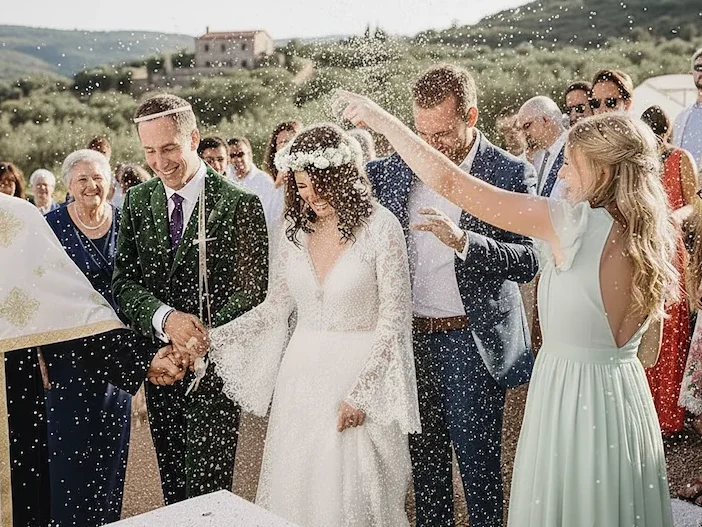
Yes. And this is not only about Catholics. The church looks at your baptism, not your denomination.
What it needs is simple: the non-Orthodox partner must have been baptized in water, in the name of the Father, Son, and Holy Spirit. Most Catholics and mainline Protestants (Anglican, Lutheran, Methodist, Presbyterian, Baptist and others) are baptized exactly that way, so they can marry Greek Orthodox. My Catholic husband and I are proof of it.
The wall you hit is a partner who was never baptized, or who was baptized outside that Trinity. That is the one thing the church cannot work around.
The church also asks the couple to agree that any children will be baptized and raised Orthodox. For us that was straightforward, since I am Orthodox. The church even asked us which surname our children would carry, and we chose my husband’s. That question is part of the same commitment.
So before you book anything, confirm three things: that the baptism happened, that you can prove it on paper, and that you are both comfortable with the children commitment. Everything after that is logistics, not permission.
The documents you need, and the three-to-six-month clock

This is the part that nearly cost us our date, so I want to be honest about it.
My husband was baptized in communist-era Poland and had his later sacraments in the United States. That meant there was barely a paper trail. We had to trace each document, then have it signed off by a priest in Poland, which we managed through family connections because we were not there.
Then every document had to be translated into Greek and apostilled, stamped and notarized, a full stack for each of us.
Here is the trap: those documents are valid for only three to six months, depending on the document. If they expire before the wedding, you redo them.
The scare was the last certificate. We sent the Catholic baptism certificate from Poland by “priority” post, not realizing priority to Greece can take four to five weeks. It arrived with one week to spare, while we were in Crete in January before our May wedding.
Then we carried the whole dossier to the priest. He spoke no English and read in silence for twenty to twenty-five minutes. We had no plan B if he refused. When he approved it, the relief was enormous, and he warmed up the moment he recognized my husband’s names, Petros Pavlos (Peter Paul), as two important saints.
A clean checklist of what to line up:
- The non-Orthodox partner’s certificate of baptism, plus any later sacrament records.
- A priest’s sign-off on those documents, from the parish where they originate.
- A Greek translation from an officially recognized translator. It cannot be just anyone. Greece keeps an approved list, and our full guide to getting married in Greece links to it.
- An apostille on each document.
- The whole dossier is valid for only three to six months, and the clock starts the day the first document is issued, so time it to land inside that window, not before.
Start this months early. And never trust “priority” post to be fast.
Before you lock in a date, check the church calendar too. Orthodox churches pause weddings at set times of the year, and I’ve listed the dates in the 2027 church wedding calendar.
One more permission: the Catholic side
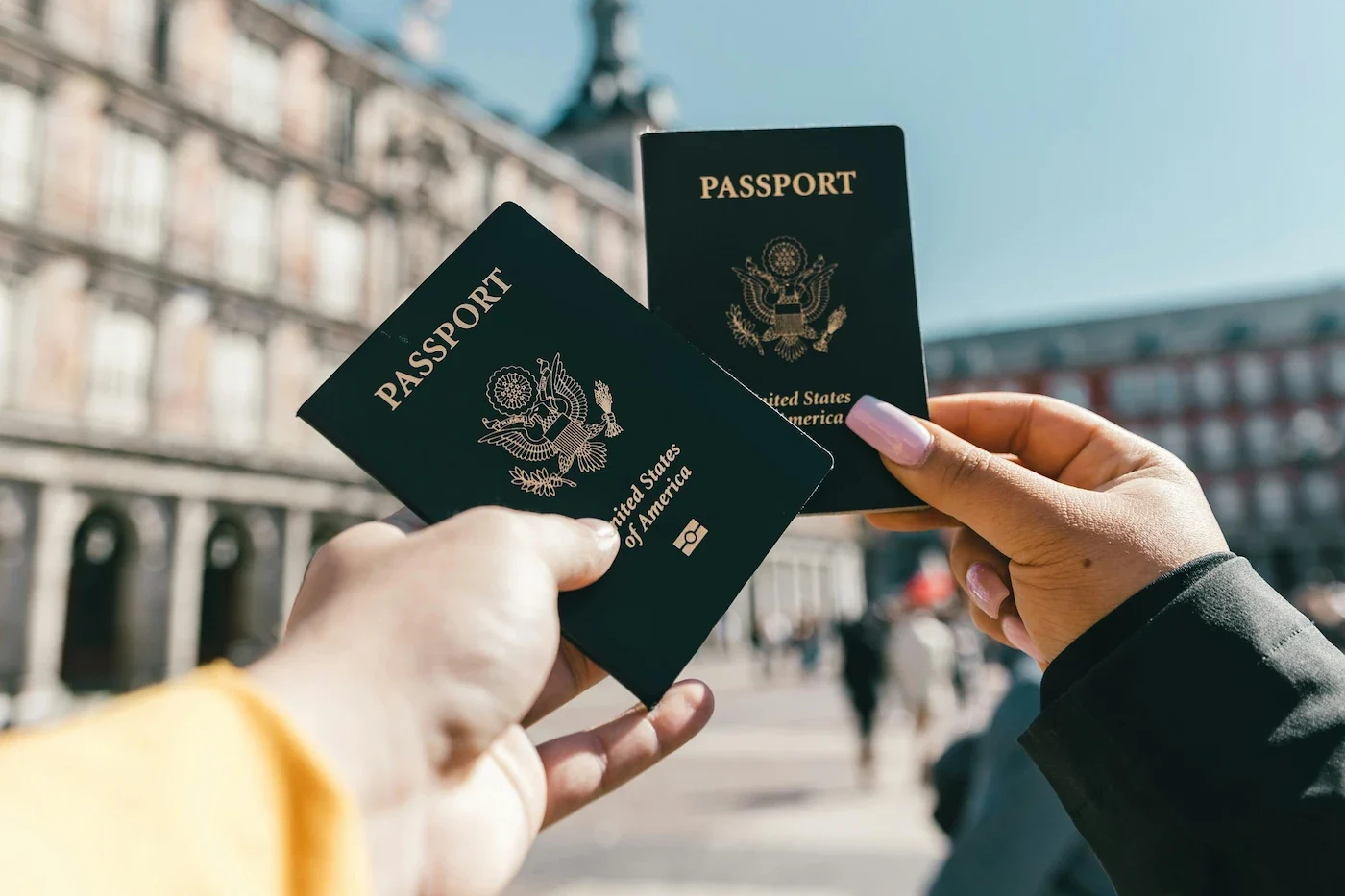
The documents above are the Orthodox side. There is a separate, Catholic-side step the Greek paperwork does not cover.
For the Catholic Church to also recognize your marriage, the Catholic partner usually needs permission from their own local bishop. It is called a dispensation from canonical form.
My husband never got one, and for us that was a deliberate choice. What mattered to us was that the Greek Orthodox Church recognized our marriage, so we did not chase Catholic recognition on top of it.
But this is a personal call. If you are the Catholic partner and you expect to stay closely involved in your Catholic parish, or you simply want your own church to recognize the marriage too, ask your home parish about the dispensation early, alongside everything you are gathering for Greece.
Do not accidentally marry twice
Here is something almost nobody tells you.
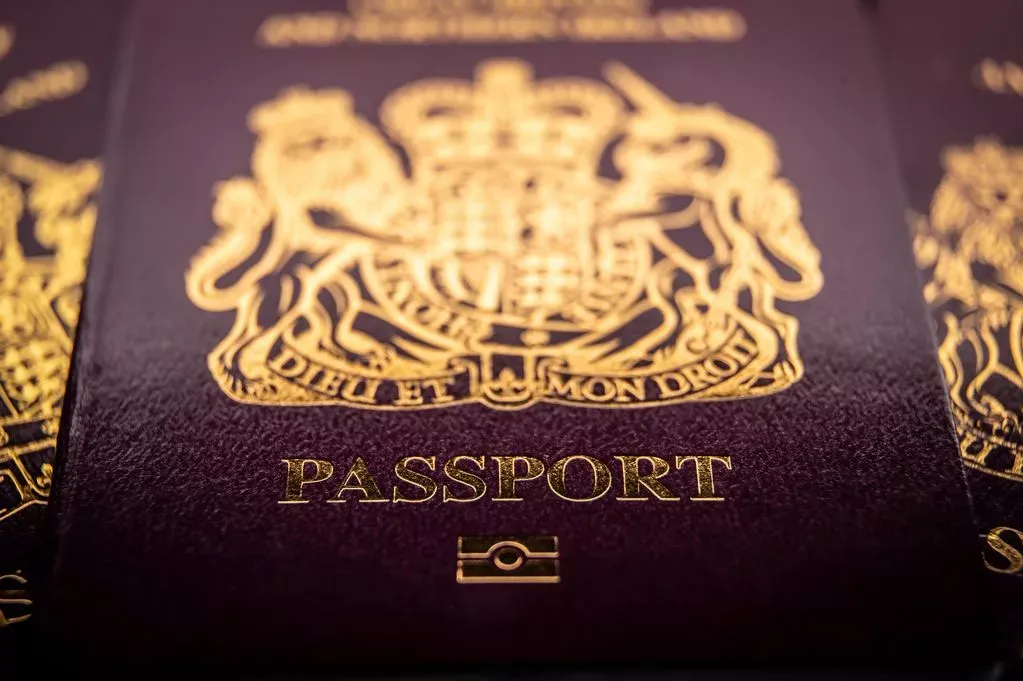
We were so nervous about the Greek paperwork that we nearly held a separate, real civil wedding in Amsterdam first, just to avoid certifying the Greek documents and translating them back into Dutch afterward. We booked appointments.
Then we were told plainly: you cannot get married twice. It is illegal.
A civil marriage in one country and then a “real” wedding in another is not two events. It is one legal marriage and a redundancy.
So decide where the legally binding marriage happens, do it once, and treat everything else as celebration. For the generic legal requirements and how the civil side works in Greece, see our full guide to getting married in Greece.
Who can stand with you when one of you is not Orthodox
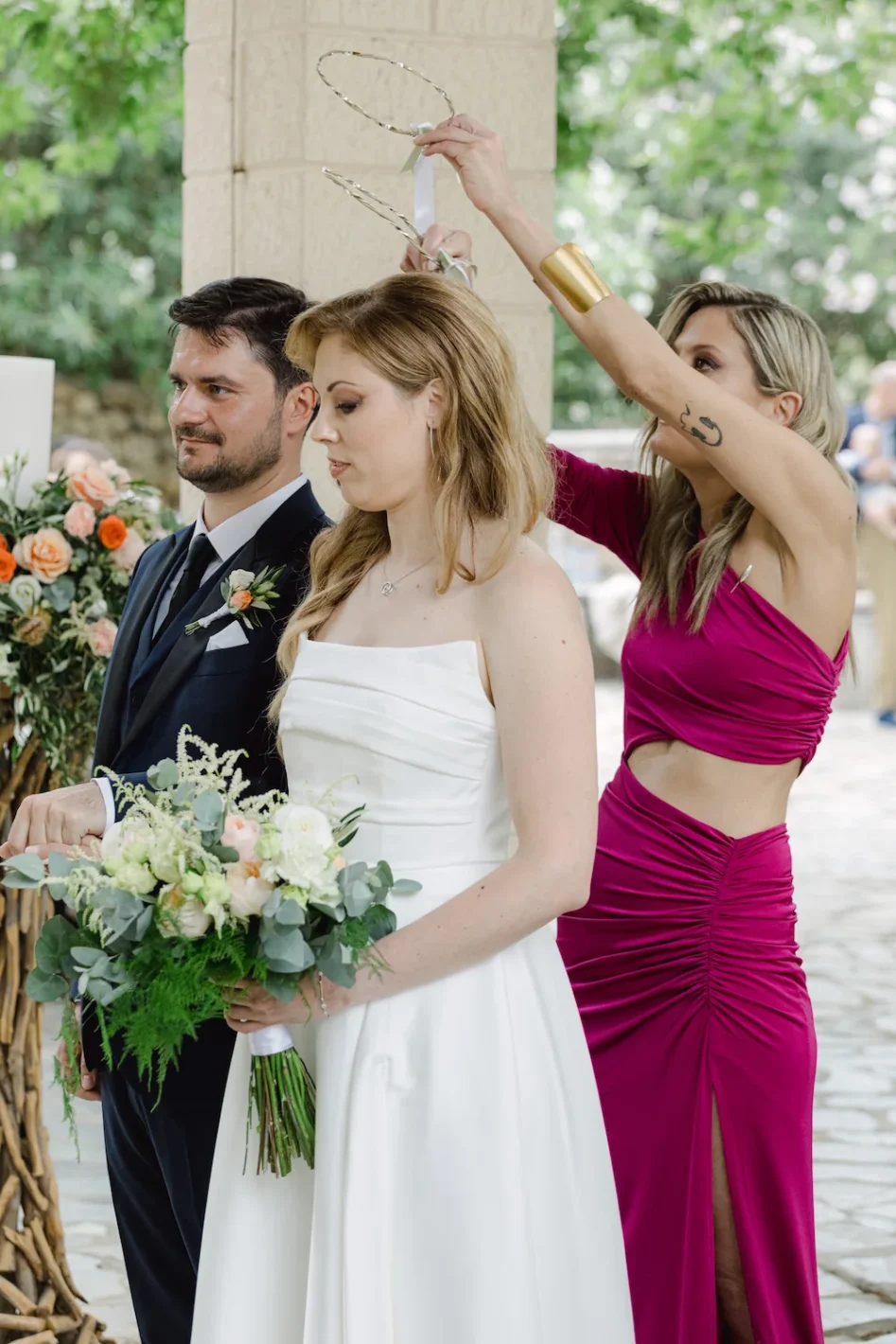
We wanted my best friend Marietta, who is Orthodox, as koumbara. And we wanted my husband’s best friend Nick, who is Catholic and unbaptized, as koumbaros.
The church could officially recognize Marietta, because she is Orthodox. It could not officially recognize Nick, because he is not baptized.
That did not mean he was left out. Our priest allowed a practical solution. Nick handed the wedding rings over before the ceremony started, stood at the altar with us, kissed the Bible, and walked the Isaiah dance, the three circuits around the altar, behind me.
The one line he could not cross was touching anything holy during the ceremony itself.
It worked beautifully. And honestly, Nick walking last and pulling faces at his kids gave us some of the funniest footage of the day.
The roles of koumbaros and koumbara run much deeper than best man and maid of honor. We cover them properly in our guide to the koumbaros and koumbara.
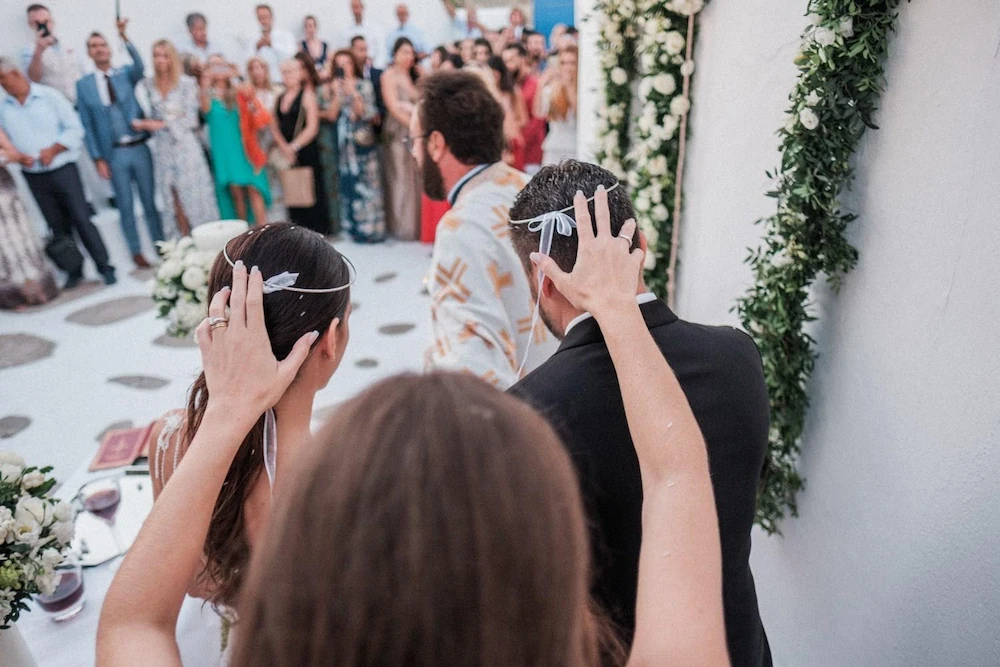
What the Orthodox ceremony actually feels like
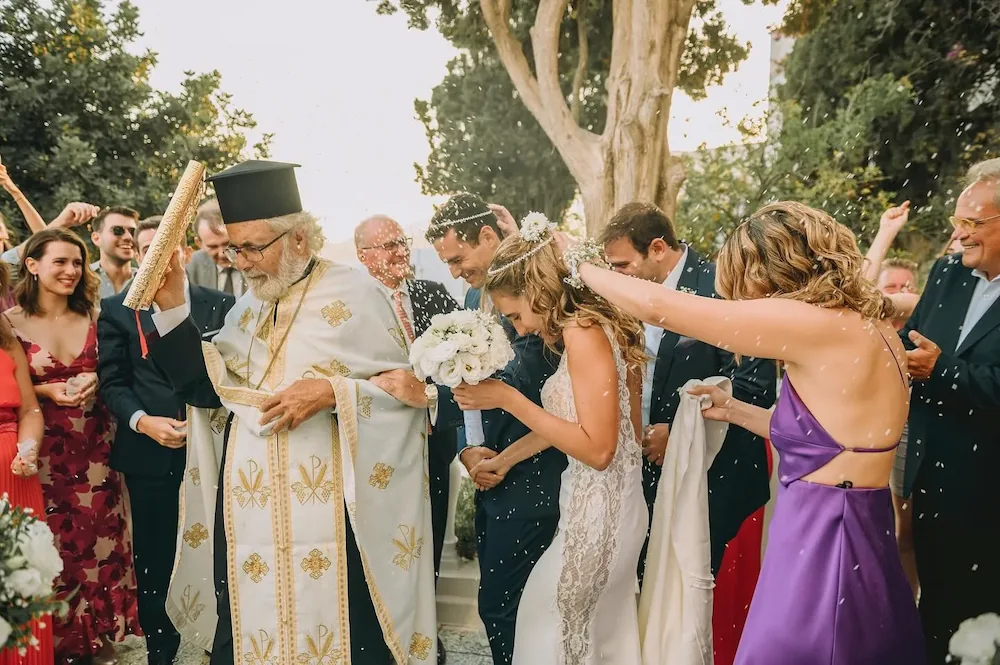
Set expectations for your non-Greek guests, because it is not a Western ceremony.
You stand for the whole thing, roughly 45 minutes to an hour. There is no sitting down partway through.
There is a common cup of wine you both drink from. And there are the crowns, the stefana, joined by a ribbon and held over you. They carry real meaning and deserve their own read in our stefana guide.
To keep it human: our chanter was the priest’s wife, and she was gloriously out of tune. There is a photo of the two of us wide-eyed, trying not to laugh.
It is a solemn, ancient, genuinely moving ceremony. It is also a warm and slightly chaotic family event. Both things are true. For more on how it fits into the wider celebration, see our overview of Greek wedding traditions.
Frequently asked questions
Can a Protestant marry a Greek Orthodox? Usually yes. What matters is that you were baptized in water in the name of the Father, Son, and Holy Spirit, which covers most Catholics and mainline Protestants, not your specific denomination. A partner who was never baptized, or baptized outside that Trinity, cannot marry the Orthodox way. The church also asks that any children be baptized and raised Orthodox.
How long are the documents valid? Three to six months, depending on the document, and the clock starts the day the first one is issued. Once translated and apostilled, each sits inside that window. If it expires before the wedding, you redo it, so time the paperwork to land close to the date.
Can my non-Orthodox best man be koumbaros? Not officially if he is unbaptized, as ours was. He can still stand at the altar, hand over the rings before the ceremony, kiss the Bible and walk the Isaiah dance. He simply cannot touch anything holy during the service. The officially recognized sponsor must be Orthodox.
Can we also have a civil wedding elsewhere? No, not as a second legal marriage. You cannot legally marry twice. Pick where the binding marriage happens, do it once, and keep everything else as celebration.
How early should we start the paperwork? Months ahead, especially if documents must be traced across countries or signed off by a priest abroad. Ours arrived with one week to spare, and that was too close for comfort.
Get your budget estimate

An Orthodox wedding is one line in a much bigger plan.
I built a free calculator using real vendor quotes from across Greece. Enter your guest count and preferences and it builds a full estimate, VAT included.
More on planning a Greek wedding
- Getting married in Greece: the full legal guide
- Koumbaros and koumbara: who can stand with you
- The stefana: the wedding crowns explained
- Greek wedding traditions
We did the Orthodox wedding because marrying each other meant joining each other’s culture, and we wanted the people who flew across the world to see the real tradition, not just a party.
It threw a real wrench into our planning. It was also one of the most meaningful things we did.
If that pull is in your heart too, start the paperwork early, keep your sense of humor for the chanter, and it will be worth it. Gia mas, and here is to your day. Christina
