

I want to start with something sensitive, which is wedding etiquette.
The etiquette of any tradition is tied to the culture you live in, and it shifts again inside that culture, from one subculture to the next. There’s no one right answer to any of it. There’s what the community you live in would think if it heard what you did, and what the communities around it would think.
Two of our friends taught me that.
A friend of ours married a woman who is Motswana, from Botswana. Before the wedding he was asked to join a call with her family about bogadi.
Bogadi, called lobola in much of southern Africa, is bridewealth: cattle given by the groom’s family to the bride’s family, negotiated between the two families rather than set by either one of them. It formalizes the marriage, it ties the two families to one another, and under customary law it legitimizes the couple’s children. It’s a commitment and a bond, not a purchase, and it is often paid over years, long after the couple are living together. The negotiation is normally done by a delegation of elders and extended family on both sides.
He declined, politely. Not because there was anything wrong with the custom, but because it wasn’t his, he didn’t feel he could take part in it honestly, and they were getting married in Amsterdam. Her family understood him and he understood them. Nobody in that story was doing anything incorrect.
Another friend, Belgian, got married in Belgium and invited one of our group to only part of it. We thought that was extraordinary. It was a standing joke among us for a while.
In Belgian and French custom, which his family follows, a wedding comes in parts, and the invitation tells you which parts are yours. One card covers the ceremony and the vin d’honneur, the drinks reception straight after it. A second card covers the evening, the meal and the dancing. A wide circle is asked to some of the day and a smaller circle to all of it, and the cards say plainly which one you have, so nobody has to guess.
We were the ones who didn’t know any better, not him. And we do the same thing in Greece without noticing: a Greek church wedding is open, anyone can walk in off the street, and the dinner afterwards is a different, invited list. A foreign guest could easily read that as a snub too.
None of this causes anybody trouble while everyone in the room grew up with the same version of it. The trouble starts when you mix etiquette and culture and tradition across the globe, which is exactly what a wedding abroad does. That’s the thing all of us are dealing with, and it’s why the question keeps coming back in wedding forums: who pays for which parts of a guest’s experience, and whether accommodation is one of them.
What follows is my own experience and my own perspective, and yours will not be the same. If you live in a diaspora community, a Greek American or a Greek British family for example, your sense of the right thing to do may be firmer and older than the one held in Greece today. And the more traditional side of a family can push hard for you to cover accommodation, while you are the one looking at the bottom line on a spreadsheet.
For our own wedding we decided to pay for our closest friends and family to stay near us. We wanted the wedding to be reachable for them, and it mattered to us that they were there for it. It blew our budget a little out of the water. Our ceiling was a tight €20,000, and €7,432 of what we actually spent was accommodation we had never planned to pay for. In the end I felt we had done the right thing.
What carried me was the culture I come from. For me the strongest part of being Greek is philoxenia, the deep welcome of foreigners: the hospitality, the taking care of your guests, the sense that an evening like that belongs to everyone in the room and not only to me. It’s about what people take away from the day, how they think of you as a host, and how they remember it many years from now.
Table of Contents
Who pays for guest accommodation at a wedding abroad?
Your guests pay for their own flights and their own rooms, and you pay for the wedding itself: the ceremony, the food, the drinks, the music, the getting home at the end of the night. Beyond that there’s no rule, only what the people around you expect. Plenty of couples cover a few nights for parents and siblings, and for anyone who genuinely could not otherwise come, then negotiate a group rate so everybody else pays less. Plenty of couples cover nobody at all. When you marry abroad you are asking people to spend a flight and most of a week on you, so whatever you decide, tell everyone which is which early enough for them to plan, and put it in writing.
We covered two nights of accommodation for eleven close family members, and rooms and flights for a handful of other people who could not have come otherwise. We did it because it felt like the right thing to do, and because we wanted those people there with us on the day, not because any rule told us to. Everyone else got a discount code and paid their own way, and we said so early.
What we paid for
- The ceremony, the venue, the catering, the bar, the photography, the flowers, the music
- Transport home at the end of the night
- Two nights of accommodation for our closest family
- Rooms and flights for the few people who wouldn’t otherwise have made it
- A farewell brunch on the Sunday, for pretty much everyone still on the island
What our guests paid for
- Their flights, booked off a date we gave them as early as we could
- Their rooms, at a rate we had negotiated down for them
- Their own drinks at the informal Friday gathering, which we told them up front
What happens when you mix two traditions at one wedding?
Everything that was obvious at home stops being obvious. That’s the real problem with a destination wedding, and it isn’t the flights or the paperwork. You are putting several sets of assumptions about who pays for what in the same room, and none of them is labeled. It’s not only about which countries are in the room, either. Communities abroad tend to keep the version of a custom they arrived with.
So the question to work on isn’t what the rule is. It’s whose expectations are actually in your room. Ask your own parents what they are picturing, then ask your partner’s parents separately, because there is no reason for the two answers to match.
What did we decide to pay for, and what did we not?

We decided to cover the people closest to us, and to be honest with everybody else that we couldn’t do more than that. So: two nights of accommodation for eleven close family members, my mother, my husband’s parents, our aunts and uncles, his siblings. Then rooms and flights for a small group who wanted to be there and couldn’t have paid their own way to a Greek island in May.
Everyone else got a negotiated discount code and paid for their own room. The informal drinks on the Friday were informal precisely because we weren’t paying for them, and we said so when we invited people. My husband’s parents paid for the rehearsal dinner themselves, which is an American tradition that isn’t ours, and it never touched our budget at all.
I want to be clear that this is a middle position, not a principle. We didn’t cover everyone. We wouldn’t have been able to.
Three separate things pushed us there, and they are worth separating because you may only have one of them.
The first is reciprocity inside a family. My cousin covered accommodation at her wedding, so returning that was something close to an unwritten rule.
The second is plain need. We had friends and family flying in from across the world, and some of them don’t have that kind of spare cash sitting around. If we wanted them in the room, we had to make it possible.
The third is philoxenia, and it’s the one that carried me when the number got uncomfortable. A guest is your responsibility while they are with you, and these were the people we most wanted in the room.
What did covering our guests actually cost us?
€7,432, and we hadn’t budgeted a cent of it. We set ourselves a ceiling of €20,000 for the whole wedding. We finished at €37,933 all in, nearly 18,000 over our own limit, and 7,432 of that was rooms we had never planned to buy.
It stretched us and we knew it would. I’d make the same decision again.
Here is the shape of it, since the accommodation line never sits on its own.
| The item | Who paid for it | Where it sits |
|---|---|---|
| Venue, catering, bar, photography, flowers, the lighting including the upgrade, music, transport home | Us | Inside the €37,933 |
| Two nights for eleven close family, plus rooms for the guests who could not otherwise have come | Us | €7,432, inside the €37,933 |
| Every other guest’s room | The guest, at a rate we negotiated down for them | Never our money |
| Rehearsal dinner, Friday | My husband’s parents | Never our money |
| Informal drinks, Friday night | Guests, and we told them so in advance | Never our money |
Two things in that table are worth more than the numbers. One is that somebody else paid for a whole event. The rehearsal dinner is an American tradition and it was his parents’ to host, so that part is ordinary enough. What was not ordinary is that at a wedding abroad, where we were controlling every other moving part, one whole evening of it was not ours to run. If a parent offers, let them, and then be precise about what their money covers so that nobody is surprised later. The other is that we said no to something in public, the Friday drinks, and it cost us nothing socially, because we said it at the invitation stage rather than at the bar.
We also paid for two things that sit outside that table: a farewell brunch on the Sunday, for pretty much everyone still on the island, and the drinks on the Thursday, when people started arriving early and we all ended up in the same bar. Neither was planned.
Our full cost picture, category by category, sits on what a wedding in Greece really costs.
How do you bring the bill down without charging your guests?

Negotiate a group rate, and make sure the code works for the guests you’re not paying for. That single sentence is the most useful thing on this page.
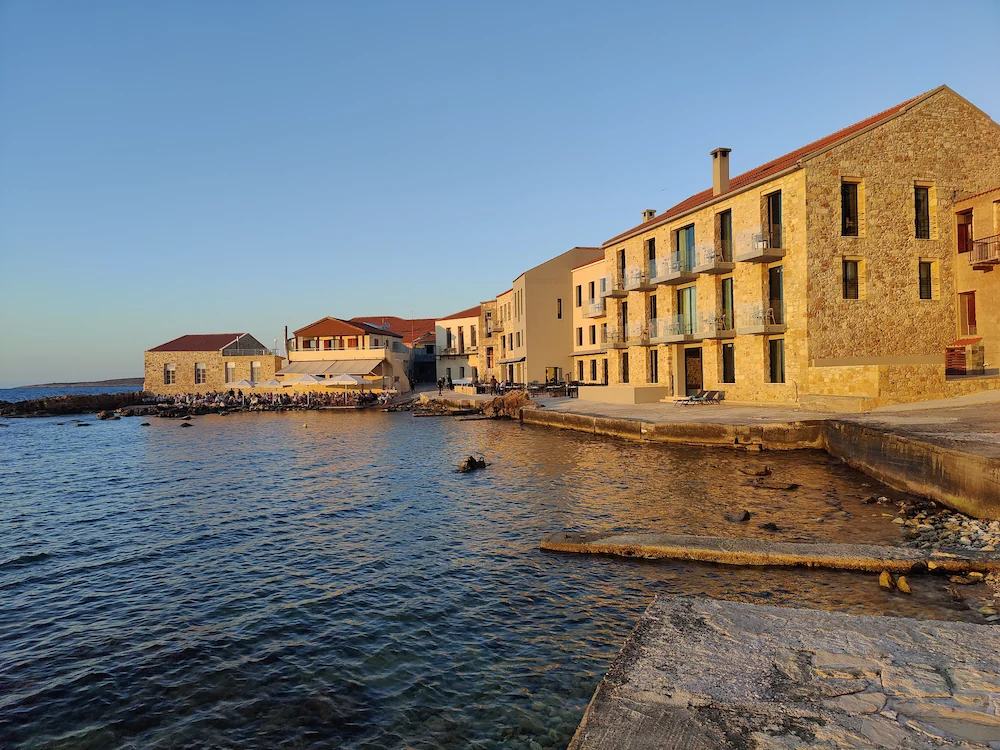
We booked two hotels next door to each other in Chania, a two-minute walk apart. One was the more premium of the two, where we stayed. The other was more affordable and just as lovely, so guests had a real choice of price rather than a single rate to accept or refuse. We went to the management ourselves, early, with a block of rooms and a pitch: guarantee us a discount and a code that works even for the guests we’re not paying for, and you’ll sell out. And we agreed prices on a few Airbnbs in the same few streets, for anyone who would rather have their own place.
It worked because we were asking at a moment when it was worth their while. We married in the middle of May, in the shoulder season, when a hotel doesn’t yet know whether it’ll fill. A guaranteed block of rooms is genuinely valuable to them then, in a way it isn’t in August.
What our guests got out of it was a lower rate, an easier booking, and a front desk that was expecting them by name. What we got was a wedding where everyone was staying within a few minutes of everyone else, and kept bumping into each other for days before the ceremony.
What if the venue is also where everyone sleeps?
Then the arithmetic changes, and it changes before you get a say in it. Where the contract commits you to the whole property, the bedrooms are already inside your venue bill, so there’s nothing to pass on to a guest and nothing to negotiate. Read the terms on exclusive use, minimum stays and whether guests may book elsewhere before you sign anything, and price those bedrooms as part of the venue rather than as a line you can pass on. If you are weighing a villa at all, our article on private villa weddings in Greece has the fuller picture.
What do you tell your guests, and when?

Tell them what is covered and what is not at the same moment you tell them the date, and never later than that. People are booking flights against your wedding. The kindest thing you can do is let them do the math early, while they still have the option of saying no.
In practice that’s four lines in a save the date or on a wedding website: the dates, the nearest airport, the hotels with the discount code, and one plain sentence saying which parts of the weekend are hosted. If you’re covering rooms for a few people, tell those people privately and don’t announce it.
Then leave the door open. Somebody you love may decline for money and say it’s work, and you’ll never know. Expect a real drop between the list in your head and the people in the room, which is what our article on destination wedding attendance rates is about.
Write the accommodation line into your budget now, before you fall in love with a venue, so you find out today whether you can afford to cover anyone at all.
I built a free calculator using real vendor quotes from across Greece. Enter your guest count and preferences and it builds a full estimate, VAT included.
Frequently asked questions
No. Most of our own guests paid for their own rooms. What reads as rude isn’t the cost, it’s the surprise: a guest who finds out about a minimum stay after booking a flight has a fair complaint. Publish the numbers with the date.
No, and plenty of couples don’t. We chose to cover two nights for our closest family because of a favor inside my own family that I wanted to return, and because some of them could not otherwise have come. If your parents are contributing to the wedding, or are comfortable, this is a conversation rather than a bill.
Let them, and then write down exactly what their money covers. My husband’s parents paid for our rehearsal dinner in full, which is an American tradition and not a Greek one, and it never touched our budget. Vagueness about who’s covering what is how a generous offer turns into an argument.
Yes, and in some countries it’s standard. French weddings do it formally, with the invitation naming which parts are yours. The thing that makes it work is that it’s said plainly and in advance, in the invitation itself, rather than being discovered by the guest on the day.
Not necessarily, and it depends entirely on what you’ve already asked of them. If your wedding party is flying, buying an outfit, and taking a week of leave for you, covering their rooms is a fair way to recognize that. If your budget won’t carry it, a negotiated group rate and a very early heads-up is a real substitute.
If you want to know whether covering anyone at all is realistic for you, put your own numbers in before you start looking at venues. It takes about two minutes.
More on planning a wedding in Greece
- What a wedding in Greece really costs
- Private villa weddings in Greece
- Destination wedding attendance rates
- 10 tips for planning a destination wedding in Greece
- How to vet a Greek wedding venue
Sources
- Bogadi in Tswana marriage: BeingAfrican, “Tswana Marriage Practices”; Dictionary of South African English, entry for bogadi. Supports the description of what bogadi is and who conducts it. Read 2026-09-12.
- The bridewealth versus bride price distinction, and bogadi’s role in legitimizing children under customary law: Springer, “Bogadi Practice and the Place of Women in the Botswana Society”.
- French wedding invitations and the vin d’honneur: Fete24, “What is the etiquette for inviting guests to a French wedding”, https://fete24.com/en/news/what-is-the-etiquette-for-inviting-guests-to-a-french-wedding, read 2026-09-12. Supports the claim that a French wedding is invited in parts and that the card says which part is yours.
- All euro figures: our own wedding in Chania, May 2024. The budget, the total and the accommodation figure are published on our cost of a wedding in Greece article, which also breaks the ranges down category by category.
