

I planned my own wedding in Crete from the Netherlands, handled every document from abroad, and I now advise couples in return. I take no commission from any vendor.
Recently I came across a Greece wedding guide, published in April 2026, stating that same-sex marriage isn’t legally possible in Greece. That is not true. In fact, Greece is one of the best countries in the Mediterranean for a legal same-sex marriage.
A same-sex wedding in Greece is legal, and it has been since February 2024. In the first ten and a half months alone, 182 same-sex couples were legally married in Greece. A couple reads that false article and quietly crosses Greece off a list it belongs on. That’s the whole reason this article exists.
It’s also what separates Greece from the four other Mediterranean countries I checked it against. France and Spain will both marry you, but one of you has to live there or hold a passport from there first. Italy and Cyprus will hold you a beautiful ceremony and hand you a partnership rather than a marriage. Greece just marries you.
That’s the easy half of the answer, and I don’t think it’s the half you came for. Greece is also a deeply traditional Orthodox country, and a law passed in Athens tells you nothing about how the registrar will look at the two of you, or the woman who runs your hotel, or the table next to yours at dinner. That is what couples are really choosing when they keep landing on Mykonos. Not legality.
In this article I explore both the legality but also the Greek Philoxenia (deep welcome of foreigners) and how it applies to same-sex couples that want to get married in Greece.
And before diving into any legal paperwork, consider the thing that takes the legal question off the table. A symbolic ceremony has no paperwork at all. None. It can happen anywhere in Greece, on a beach or under an olive tree or on somebody’s terrace, and anyone you love can stand up and marry you. You can sign the legal papers quietly at home and keep Greece for the day itself. Either way you end up just as married.
Table of Contents
Can we legally marry in Greece as a same-sex couple?

Yes. Two people of the same sex can enter a civil marriage in Greece, and you do not need to live here to do it. Since 16 February 2024 the Greek Civil Code has said that marriage is contracted between two persons of different or of the same sex.
The requirements are identical to those for a different-sex couple. Proof that you are free to marry, apostilled and translated into Greek, filed in person at the town hall of the municipality where you will marry. Two witnesses over 18, one of whom can interpret, because the ceremony is conducted in Greek. Then registration within 40 days. The town hall fee is 0 to 150 euro, and you should allow several weeks for the paperwork rather than several days.
How does Greece compare to France, Spain, Italy and Cyprus?

Greece is the only one of the five that will hand a marriage certificate to two people with no connection to the country. That is worth knowing, because the other four all advertise weddings to foreign same-sex couples and what they give you at the end is not always the same thing.
| Where | What you get | Tie to the country needed? |
|---|---|---|
| Greece | Marriage | No |
| France | Marriage | Yes |
| Spain | Marriage | Yes |
| Italy | Civil union | No |
| Cyprus | Civil partnership | No |
Source: BigFatGreekDay.com 2026 research on same-sex marriage in Greece, statutes read August 2026.
France and Spain will both marry you, but one of you has to either hold the local passport or prove a residency period. Spain wants a permanent home. France wants a month living in the commune, or a parent of one of you living there. Italy and Cyprus will give you a real, legally binding ceremony, often a lovely one, but the paperwork at the end of it says civil union or partnership rather than marriage. Their vendors quite reasonably use the word wedding for what they do, and if you want it to count as a marriage when you get home, that difference matters more than anything else on their website.
Which places in Greece say they welcome LGBTQ+ couples?
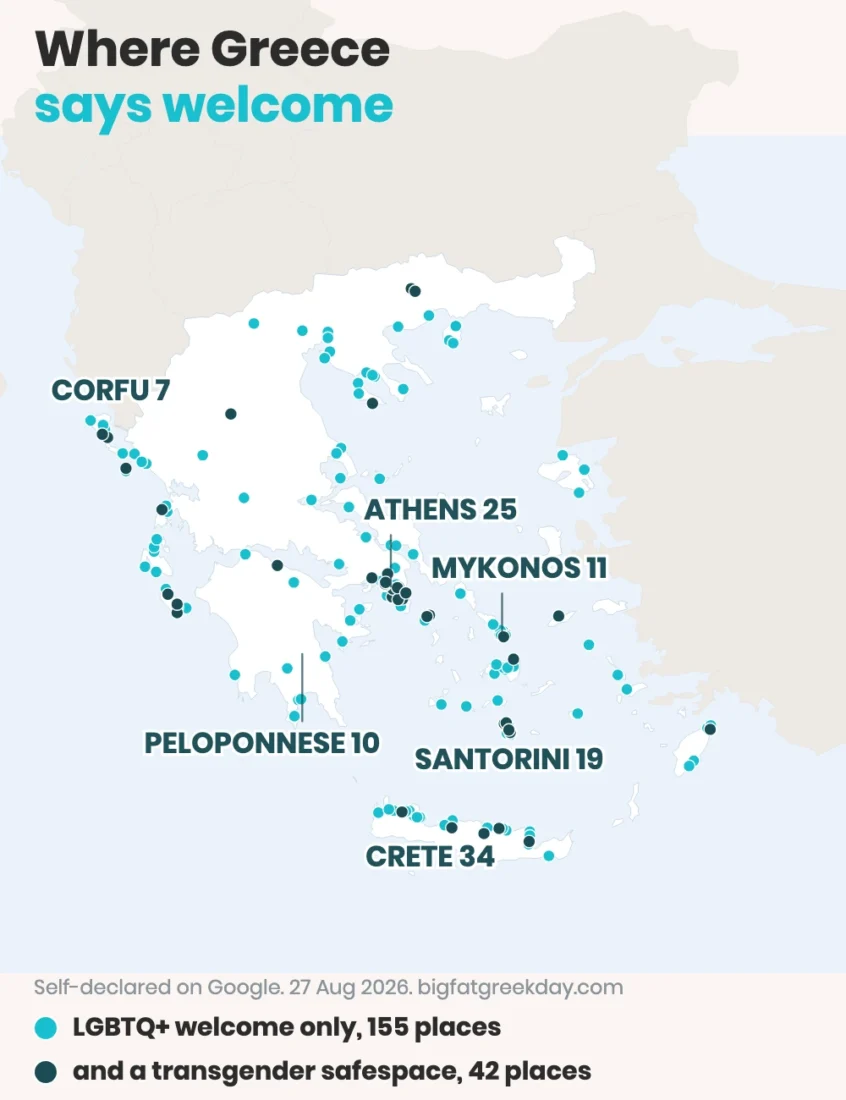
197 hotels, resorts, villas, venues and holiday homes across Greece publish Google’s LGBTQ+ welcome attribute, and 42 of those also declare a transgender safespace. Google lets a business tick that box on its own public profile, under its own name, on the page its customers read. I could not find anyone who had counted them, so I did.
They are not where the internet or you might guess they are. Crete has the most at 34. Then Athens with 25 and Santorini with 19. Mykonos, the answer everyone gives, has 11. The rest run from Rhodes and the Dodecanese in the southeast to Thessaloniki and the north, out to Lesbos in the east, and into mountain towns that nobody markets this way at all.
Two caveats, because a count like that is easy to over-read. Nobody at Google checks these, so it tells you what a business chose to say in public and roughly half of all Greek listings publish no attributes at all, so a venue that is missing has almost certainly just never filled the form in. If you love a place that is not on the list, write and ask.
Then there is the country around the venue. 60 percent of Greeks now say same-sex marriage should be allowed, against 36 percent when the question was first asked in 2015. But only 35.8 percent support same-sex couples adopting, and more than half of Greek marriages are still religious rather than civil. Greece has moved a long way on your marriage and less far on everything around it. In a small inland village I would be a little more careful than I would be in Athens, or on an island that has been hosting the world every summer for decades.
Where do same-sex couples actually get married in Greece?
Mostly in places where the town hall already marries foreign couples in volume: Athens, Thessaloniki, and the island municipalities with busy civil wedding seasons. Mykonos is the answer everybody gives, and it is not a wrong one. It has been an international gay destination for decades and nobody there is going to blink. It just is not the whole map.
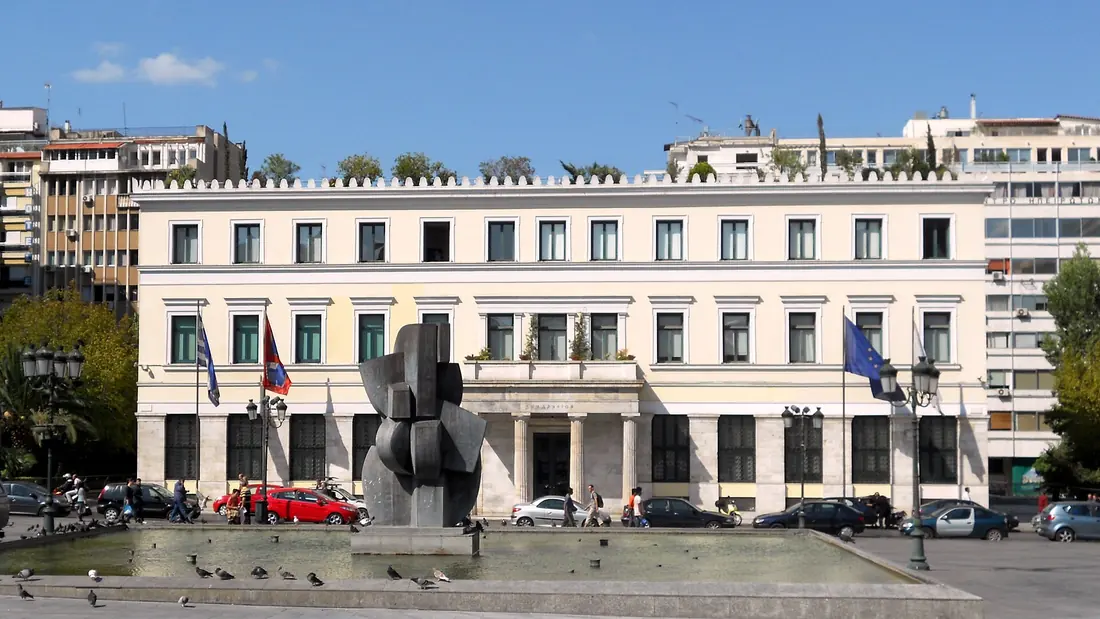
The cities went first. Greece’s first same-sex marriage was in Nea Smyrni, a suburb of Athens, in early March 2024. Days later the Mayor of Athens married a novelist and a lawyer at Athens City Hall himself, with about two dozen guests watching.
Thessaloniki has numbers attached, and they need reading carefully. Twelve of the 483 civil ceremonies at the city’s town hall in 2024 were same-sex. But the same municipality issued 945 licenses that year, so roughly half the couples who got one married somewhere other than the town hall. If you are marrying at a venue, you are in that half, and nobody is counting you.
Then the islands. Chios had its first, two women, at a village town hall in September 2024. Chalki in the Dodecanese announced its first for two Italian men. In July 2025 two Canadian women were married by the local authority in Eressos on Lesbos, in the small community building in the village, with the wedding meal afterward down on the beach. The deputy mayor who married them called it a historic moment for the area, on the record.
Rhodes performed no same-sex civil weddings at all in 2024, which reads like a verdict and is not one. Foreign couples book Rhodes one to two years ahead and the civil wedding season runs April to October, so the first year of a new law was always going to look empty there.
Nobody has published a case of a Greek municipality refusing a same-sex couple. The one local report suggesting reluctance, in Piraeus in May 2024, was contradicted the next day by the deputy mayor it named. The official who performed the very first one said nothing changed on paper, the only adjustment was to a ministry form, and residents did not react in any way worth mentioning. He also said his own town is unusually open, and I would take him at his word on both halves.
So the pattern I would take home is this one. Legal same-sex weddings turn up where the counter is busy, not where the scenery scores highest. Pick a town hall whose staff have done this forty times this season, and a lot of the anxiety goes away before you arrive.
Which planners and venues say it themselves?

Every business below is in our own directory, so I have checked it, and each one separately says it in public on its own Google profile or listing.
This is not a shortlist of that map. The map counts anywhere in Greece you could stay or hold an event. This counts businesses I researched and listed myself, which is why Crete leads the map and appears here as planners rather than venues.
Planners
- Wedding Tales Crete, Crete. Isabela lists same-sex couples and vow renewals as services, and walks couples through the documents, translations and submissions. If the paperwork is the part frightening you, start here.
- Make Happy Memories, Greece-wide. Names LGBTQ+ weddings handled with explicit care, and celebrations over a hundred guests.
- Rock Paper Scissors Events, Athens. Built around American families planning from abroad, with a weekly task list. Their work includes a gay Jewish wedding.
- Royal Blue Luxury Events, Crete. Carries the LGBTQ+ welcome on its own Google profile.
Venues
These eight are beautiful, and they aren’t the only ones. There are more venues in our directory that might suit you better, so find the place you love first and write to them through the directory. Four of the eight go further and declare a transgender safespace as well: Bello Blu, Lythos, Ekaterini Estate and Palazzo di P.
- Bello Blu Luxury Villa, Rhodes. Seven ensuite bedrooms on a clifftop, room for 130. One of Christina’s Picks for 2026.
- Ekaterini Estate, Gastouri, Corfu. Neoclassical estate with a garden chapel, eight bedrooms, room for 250.
- Lythos, Kiotari, Rhodes. Family run seaside venue with its own in-house planner, seating 220.
- Palazzo di P, Romiri, Zakynthos. A palazzo inside olive groves, five ensuite bedrooms, reception space for 200.
- Canaves Oia Suites, Oia, Santorini. Cave-style suites in the cliffs, made for micro weddings and elopements, up to 30.
- Carpe Diem Santorini, Pyrgos, Santorini. 270 degree caldera views, elopement up to 150 guests.
- Islet Santorini, Fira, Santorini. Private clifftop estate, exclusive use, terrace space for 120.
- Agrilia Koromili, Boeotia. Stone suites above Koromili Beach, 87 km from Athens, private beach and a chapel, for 30.
A venue missing from that list means nothing at all, because most of our directory has simply never been asked the question. Write to any of them through the enquiry form on their listing. What comes back will tell you more than any badge.
Should we choose a symbolic, civil or religious ceremony?

For most foreign same-sex couples it comes down to civil or symbolic, because the religious route is not available to you in Greece.
Start with the symbolic one, because it takes the paperwork off the table completely. A symbolic ceremony has no legal standing here, which sounds like the drawback and is actually the whole point. No legal standing means no license, no eight-day wait, no apostille, no certified translation, no witnesses with their passports, no forty-day deadline and no fee to any town hall. It can happen anywhere, and anyone can lead it. You marry legally at home, where the paperwork is boring and fast, and then you come to Greece and have the day. Greek planners sell exactly that as its own product, and on Lesbos couples were celebrated this way for years before the law changed.
There is one catch, and it is not about the marriage. No paperwork for the ceremony does not mean no permission for the place. A public beach sits under rules about the use of public space, and a hotel or private estate will set its own terms whatever you are calling the day. The question is never whether you need a permit to get married there. It is what the venue needs from you to hold a ceremony on that spot. Ask in writing before you pay anything.
If you want the marriage itself to be Greek, the civil route is the one open to you.
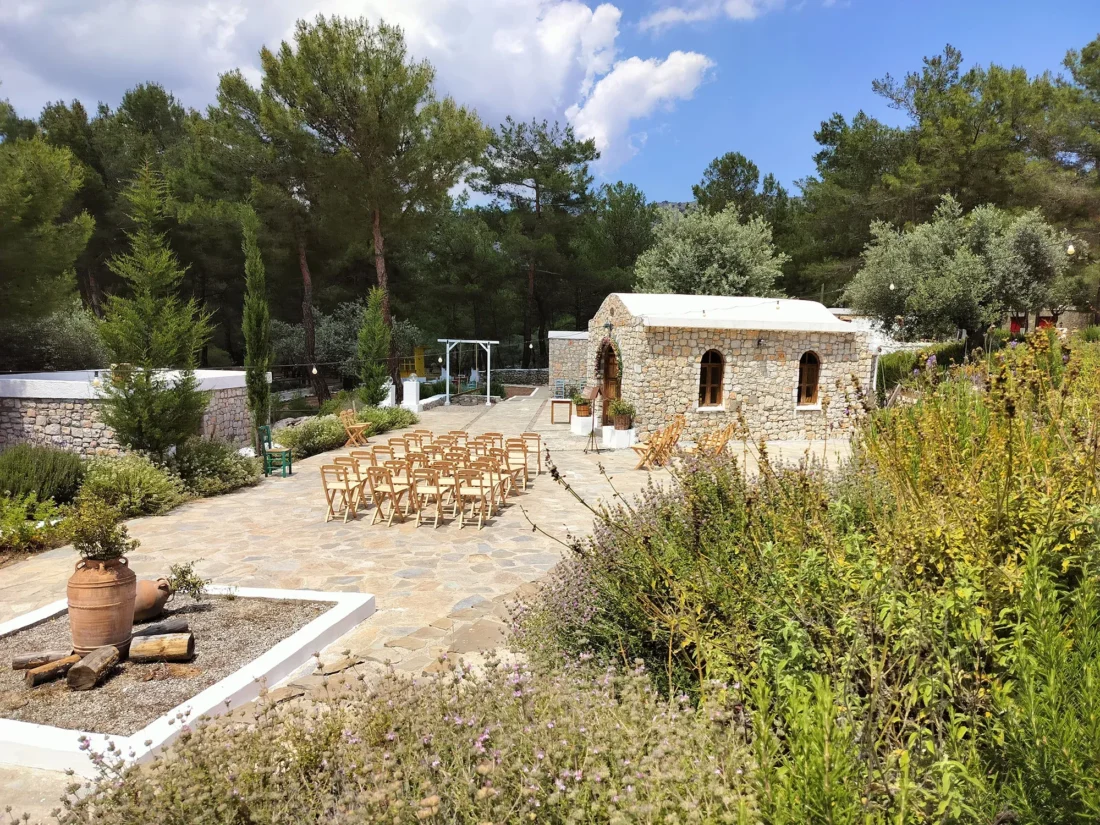
My husband and I married in an Orthodox church in Chania, which is the wedding this page is telling you that you cannot have. I would rather say that plainly than write around it. What I can tell you is that the civil route gives you more than couples expect. Once the license is issued, the ceremony can be held anywhere in Greece and the setting is entirely yours: an olive grove at seven in the evening when the light goes gold and the heat finally breaks, a stone courtyard in a village nobody has heard of, a beach at the end of a dirt track. A registrar reads in Greek while your friend leans in and translates, which is a job she has to do anyway. Then everybody eats for four hours, which in my experience is the part people describe when they get home.
How long does the paperwork take?

Allow several weeks, not several days. Inside that stretch there is one waiting period worth writing on a calendar: the license is generally issued eight days after you apply, and it is then valid for six months. Your apostilled documents run on their own clock, three to six months depending on the document, so treat that window as your real deadline rather than the wedding date. Do not build a five-day holiday around completing this on the ground, because it does not fit.
We planned our own wedding in Chania from the Netherlands after firing the planner we had hired, so I know this part from the queue rather than from a press release. Ours went right to the wire. One certificate we needed arrived with a single week left on it, and we were nervous enough by then that we nearly held a separate civil wedding in Amsterdam first.
If you are a couple who has been told no by an institution before, that instinct will be louder for you than it was for us. Start earlier than feels necessary.
What documents do we need, and what do they cost?

Five documents, apostilled and officially translated into Greek, plus a town hall fee of 0 to 150 euro. Greece publishes its public procedures in a national registry, and the entry for same-sex civil marriage was refreshed in July 2026 with the same documents, fee, witnesses and ID rules as the different-sex entry.
- Proof that you are free to marry. A marriage license or certificate of no impediment from your own consular or competent authority, valid six months. In Rhodes it has to name the person you intend to marry, not just say you are single. Ask your own town hall whether it wants the same.
- The apostille. For countries in the Hague Convention, an Apostille. For countries outside it, certification by the Greek Consulate.
- The official translation, by a Greek lawyer, the Greek Embassy, the Greek Ministry of Foreign Affairs, or a certified translator. Your own translation will not be accepted.
- Passports or ID, with a copy filed.
- Evidence that any earlier marriage ended, if either of you has been married before: a death certificate, or a final and irrevocable divorce decree, apostilled and translated.
US citizens have a slower version of the first step. The affidavit is sworn at the US Embassy in Athens at USD 50 each, then authenticated by the Greek Ministry of Foreign Affairs with a 30 euro paravolo, a state fee stamp. Plan on two days in Athens for it.
The fuller version of all of this, for every foreign couple rather than specifically for you, is in our guide to getting married in Greece.
Where do we file everything, and what happens on the day?
You file in person at the town hall of the municipality where you will marry, and if you are both foreign nationals, each of you submits a separate set. Nobody can do this by proxy, because the Civil Code requires the declarations to be made in person.
Once the license comes through you apply jointly to the mayor for your date, and the municipal fee is due then. You bring two witnesses over 18 with passports or Greek IDs, one of them acting as interpreter because the ceremony is conducted in Greek. Pick that person deliberately, because it is a real job on the day.
One thing genuinely varies by municipality, and it is the route to your license. Two exist and both are official: a license or certificate of no impediment from your own consular or public authority, or a Greek-side license issued about eight days after you apply. Which one you meet is set locally, and it is not something you can settle from a laptop, so contact the local city or town hall in Greece for its own requirements before you make your travel plans.
Then register the marriage at the Ληξιαρχείο (Lixiarcheio, the local registry office) of the city where it took place, within 40 days. A marriage is not legal in Greece until it is registered. Either of you can do it, or somebody else holding a power of attorney. It is the step couples forget while they are on their honeymoon, so put it in somebody’s calendar before you fly.
Will a Greek marriage be recognized at home?
In England and Wales, Northern Ireland, the United States federally and Australia, yes. Each has an express provision recognizing a marriage validly entered into abroad, and none of them excludes same-sex couples: section 10 of the Marriage (Same Sex Couples) Act 2013, regulation 10 of the 2019 Northern Ireland Regulations, the Respect for Marriage Act 2022, and section 88D of the Australian Marriage Act 1961.
Scotland is the exception, and not in the way you might fear. England and Wales and Northern Ireland each carry that express statutory provision in almost identical words. Scots law has no equivalent on the statute book. That is not a rule against recognition and it is not a rule for one either. Put the question directly to National Records of Scotland, which houses the Registrar General, or to your local registrar, before you make any plan that depends on the answer. If you find the answer, kindly email me, I’d like to know!
What are the two questions to ask first?
Which town hall answers you properly, and what the venue’s minimum is. Both can be answered in a fortnight, in writing, before a single deposit leaves your account.
The law is identical everywhere in Greece. What changes from place to place is the counter: the document list, the route to the license, the waiting time, and the fee anywhere between nothing and 150 euro. Email the municipality you are considering and ask for its document list in writing. The one that replies clearly and quickly is telling you something about your day as well as about your paperwork.
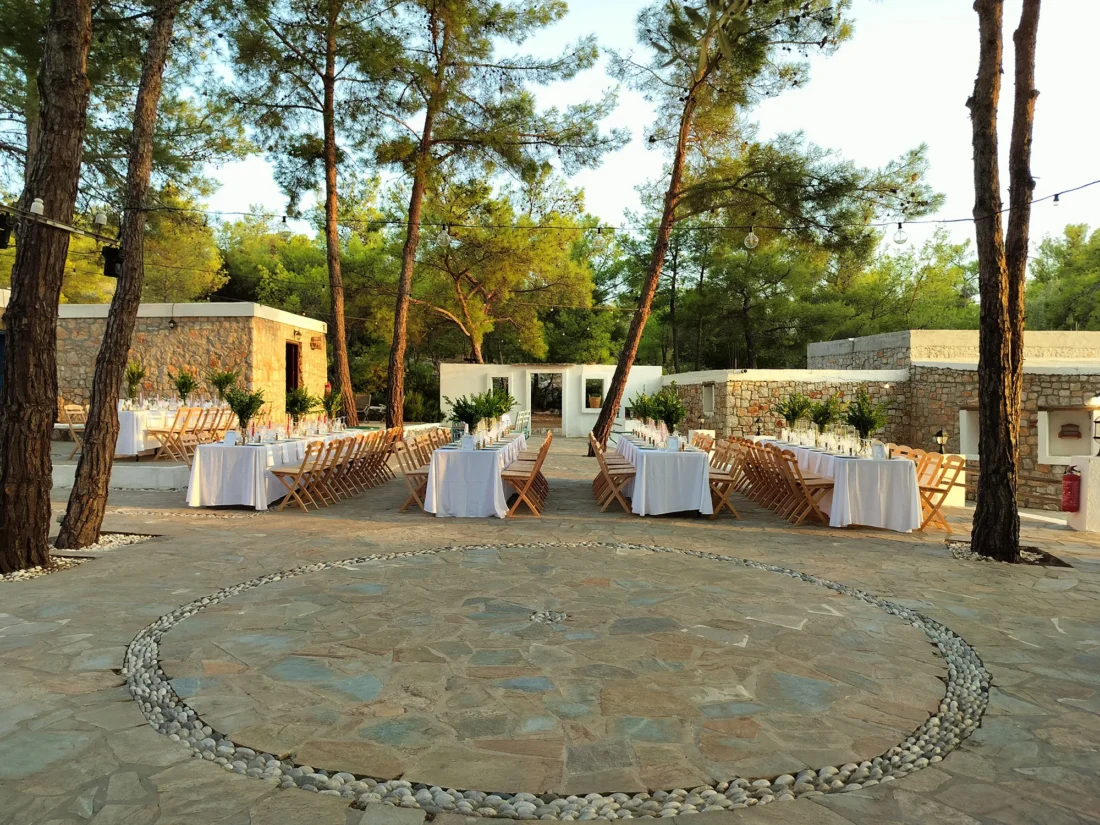
The second question is the obstacle that actually stops couples, and it has nothing to do with who you are. A venue sets a floor, either as a guest count or as a minimum spend dressed up as one, and a smaller wedding does not clear it. It lands hardest on anyone planning something intimate. Ask for it in writing before you fall in love with a place, because it is rarely on the website. Look at venues that price per head with no floor, and look outside the two or three islands everyone shortlists first, where the floors are highest. Some of the best weddings I have seen in Greece had thirty people at them.
While you are writing to the venue, ask the other thing too: have you hosted a same-sex wedding here before? A supplier who has, and says so plainly, has answered a question no survey and no travel guide can answer for you. And run one more test before you trust the rest of anybody’s website. Ask them what the legal position is. In August 2026 I looked at three Greek wedding businesses advertising specifically to gay couples, and all three still tell you same-sex marriage is not legal here. A supplier who has not caught up in two and a half years is telling you how current everything else on their site is.
After that, choose the way any couple chooses: the light, the food, the flight your guests can actually make. That part is yours.
What will the rest of the wedding cost?
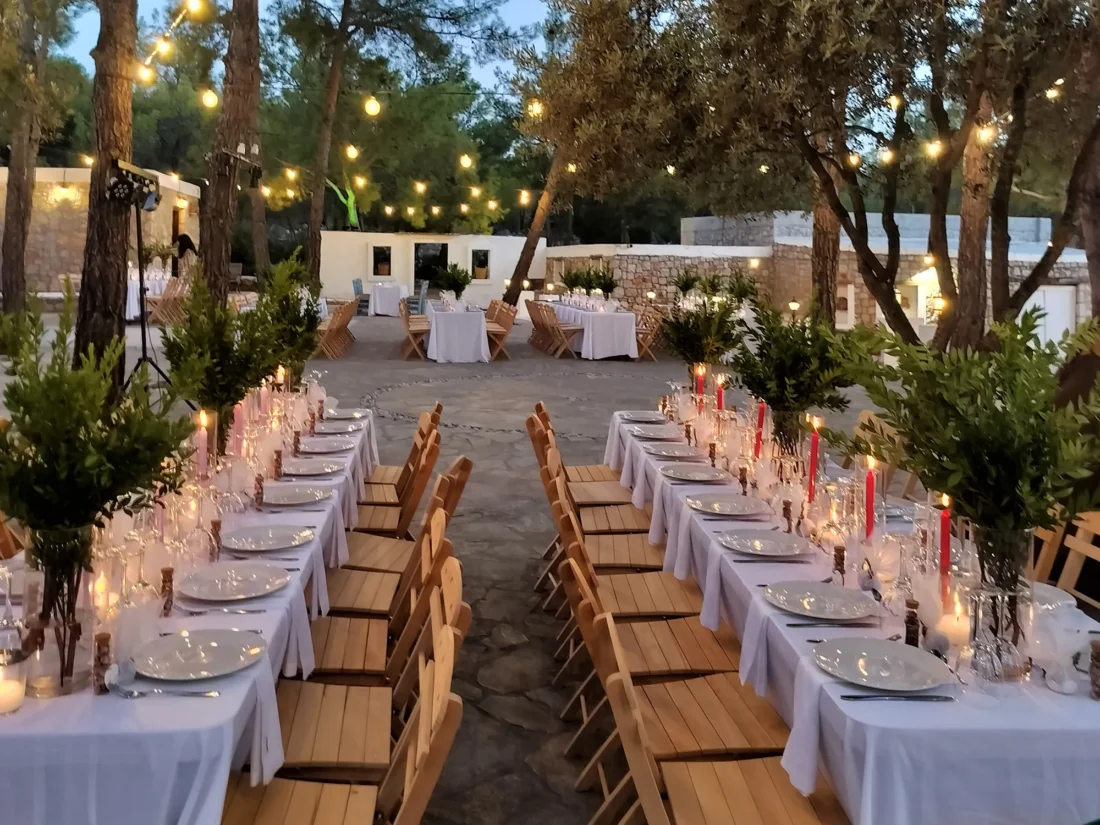
The town hall fee is the smallest number in your wedding. The catering, the venue, the flowers and the guest accommodation are where a Greek wedding budget actually lives, and those numbers are the same for you as for anybody else.
I built a free calculator using real vendor quotes from across Greece. Enter your guest count and preferences and it builds a full estimate, VAT included.
Questions couples ask
Is same-sex marriage legal in Greece?
Yes, since 16 February 2024, when Law 5089/2024 took effect. It rewrote article 1350 of the Civil Code so that marriage is contracted between two persons of different or of the same sex. Parliament voted 175 in favor and 77 against the day before. No religion is obliged to change its own rite.
Do we have to live in Greece to get married there?
No. Greek law has its own route for foreign nationals. What you need is proof from your own authority that you are free to marry, apostilled and translated into Greek, plus two witnesses over 18 with one able to interpret. That is the advantage over France and Spain, where one of you has to live there or hold a passport first. And unlike Italy or Cyprus, what you get at the end of it is a marriage.
How much does the ceremony cost at the town hall?
It is 0 to 150 euro, set by the municipality you marry in, and it is the same range for every couple. Rhodes, as one example, publishes 70 euro. Americans should add USD 50 each for the consular affidavit in Athens, plus a 30 euro paravolo for authentication.
Can we have a church wedding in Greece?
Unfortunately you cannot. Plan a civil ceremony instead. Greece recognizes both civil and religious marriage and either alone is a full legal marriage, but the 2024 law changed only the civil route and left each religion to set its own rite. The Church of Greece describes the sacrament as the union of a man and a woman.
Did the 2024 law change anything besides marriage?
Yes. It extended parental leave, protection from dismissal and anti-discrimination cover to same-sex spouses and parents, recognized parentage recorded abroad, and carried the Civil Code’s adoption provisions with it. It also gave retroactive validity to same-sex marriages Greeks had already entered into abroad.
Do we need a civil marriage, or is a symbolic ceremony enough?
It depends whether you want the marriage to be Greek, or only the wedding. A symbolic ceremony has no legal standing, so there is no license, no apostille, no translation, no witnesses and no fee. A common shape is to marry legally at home and hold the symbolic ceremony in Greece.
Sources

The lived parts of this page are mine. Everything legal was read in August 2026 and is listed here.
- Law 5089/2024, Government Gazette A 27, 16 February 2024. Rewrote Civil Code article 1350.
- Ministry of the Interior, civil marriage for persons of the same sex, updated 30 July 2026, and for different-sex persons, updated 7 August 2026. The identical procedure, the fee, and the July 2026 refresh.
- Ministry of the Interior circular 240/2024, March 2024. Adoption, and the law leaving each rite alone.
- Presidential Decree 391/1982, article 5(1). The route for foreign nationals marrying in Greece.
- Hellenic Parliament, sitting of 15 February 2024. The vote.
- Municipality of Rhodes, supporting documents for a civil marriage of foreign nationals. The 70 euro fee, and the requirement that the document names the person you intend to marry.
- Municipality of Chania, declaring a marriage. The 40-day registration deadline.
- Church of Greece, Holy Synod encyclical, 29 January 2024. The Church’s own position on the sacrament.
- US Embassy in Greece, getting married in Greece. The several-weeks timeline, the eight-day license, the US costs, and the instruction to contact the town hall.
- Greek Ministry of Justice, codified Civil Code. Articles 1350 and 1367.
- Marriage (Same Sex Couples) Act 2013, section 10. England and Wales.
- Marriage (Same-sex Couples) and Civil Partnership (Opposite-sex Couples) (Northern Ireland) Regulations 2019, regulation 10.
- National Records of Scotland, which houses the Registrar General.
- Respect for Marriage Act 2022, amending 1 U.S.C. section 7.
- Marriage Act 1961 (Australia), section 88D.
- Hellenic Statistical Authority, Vital Statistics 2024, published 3 October 2025. The 182 same-sex marriages, and 19,695 religious against 16,954 civil. Provisional, and it counts events in Greek territory only. ELSTAT’s own published share for religious ceremonies is 38.5 percent, because that denominator includes 14,486 registered partnerships.
- diaNEOsis, What Greeks Believe 2024. The 60 percent support, the 36 percent in 2015, and the 35.8 percent on adoption.
- ILGA-Europe Annual Review 2025 and Annual Review 2026, Greece chapters. Neither records any Greek municipality, mayor or registrar refusing a same-sex marriage, and both record refusals by other Greek public bodies, which is what makes that absence worth reporting.
- Ta Nea, 4 March 2024. The deputy mayor of Nea Smyrni on Greece’s first same-sex marriage, and his own caveat about his town.
- Euronews with the Associated Press, 8 March 2024. The marriage at Athens City Hall.
- PiraeusPress, 7 May 2024, and Aftodioikisi, 8 May 2024. The Piraeus report and its contradiction the next day.
- Enikos, 21 December 2024. The 12 among 483 at Thessaloniki town hall, and the 945 licenses. The 408 in that article’s headline is its 2020 figure.
- Dimokratiki tis Rodou, 19 December 2024. Rhodes in 2024, the booking lead time and the season.
- CretaOne carrying the Greek national news agency wire and LesvosNews, 31 July 2025. The two Canadian women at Eressos.
- Protothema, 21 September 2024, for Chios. Dimokratiki tis Rodou, 6 July 2024, for Chalki. Chaniotika Nea, February 2024, for the Chania announcement.
- Three Greek wedding vendor pages advertising to same-sex couples, each re-read on 26 August 2026 and each still stating that same-sex marriage is not legal in Greece. Deliberately not named.
- Google Business Profile attributes for Greek hotels, resorts, villas, wedding and event venues, wineries, retreats and guest houses, retrieved through the DataForSEO Business Listings API, 27 August 2026. The 197, the 42, and every count on the map. Declared by each business, verified by nobody. Coastline from Natural Earth, public domain.
- For the five-country comparison: French Code civil articles 74 and 64, a month of continuous residence in the commune of one of the couple or of a parent of one of them, plus ten days of banns; the Spanish Reglamento del Registro Civil, on domicile as the basis of a registry’s competence, with no residence duration anywhere in it; Italian Law 76/2016 with DPR 396/2000 articles 70-bis and 70-ter, under which two foreign visitors may enter a civil union in a comune of their choosing after up to thirty days of checks, but not a marriage; and the Cyprus Marriage Law 104(I)/2003 article 3(1), which defines marriage as between a woman and a man, with the Civil Partnership Law 184(I)/2015 providing partnership instead.
For media inquiries or citation, please reference: BigFatGreekDay.com 2026 research on same-sex marriage in Greece.
More on getting married in Greece
- How to get married in Greece: the full legal route, documents and timeline for every foreign couple
- The paperwork route for US citizens
- Planning from the UK
- The requirements for Australian citizens
- A small wedding in Greece
- Eloping in Greece
- Greek weddings: frequently asked questions
One last thing
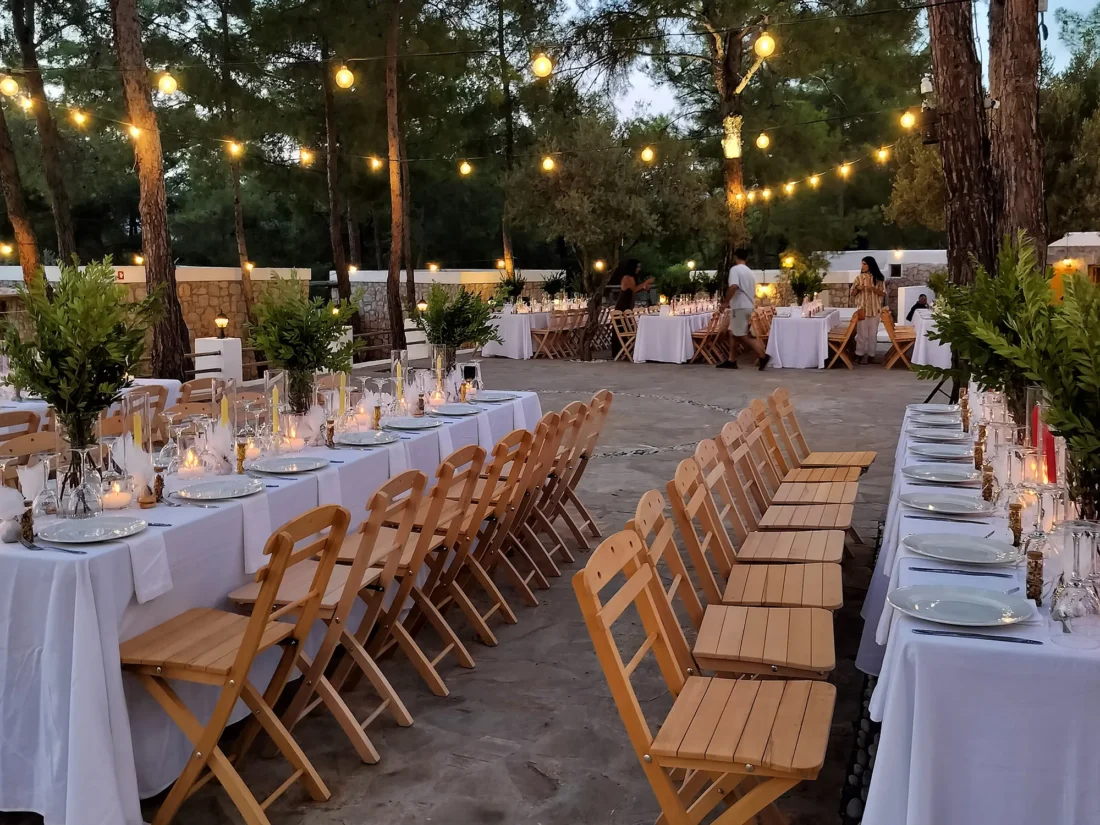
We got married in Chania on a Saturday in May with ninety-six people around us, and what I remember is not the file of apostilled documents. It is my aunt talking to somebody’s cousin at a table neither of them planned to sit at.
The paperwork is only the door. Get the document list in writing, start six months out, choose two witnesses who will take the job seriously, and then go and think about the food.
Kalo taxidi. It is going to be a good day.
